
B.Tech in Electronics and Communication Engineering: Subjects, Fees, Eligibility Criteria, Admission, Jobs & Salary (2026)
B.Tech in Electronics and Communication Engineering (ECE) is a 4-year engineering course that teaches students about electronics, communication systems, embedded technology, and modern technologies like AI, IoT, and 5G. It offers good career opportunities in telecom, electronics, semiconductor, IT, and government sectors. After completing the course, students can get well-paying jobs and also pursue higher studies for better career growth.One of the highest preferred engineering branches in India is Electronics and Communication Engineering. It covers a wide range of electronics devices, communication systems, telecommunications, embedded systems, networks and recent technologies like AI, IoT, and 5G communication.
B.Tech in ECE is a 4-year undergraduate program that will help you establish a career in the electronics, telecommunication, semiconductors, IT sectors, government sector, and more.
What is B.Tech in Electronics and Communication Engineering?
B.Tech in Electronics and Communication Engineering (ECE) is an engineering course which covers electronic circuits, communication systems, signal processing, microprocessors and wireless technologies.
The course includes both hardware and software knowledge and students can gain the technical skills needed in today’s industries.
B.Tech ECE Course Highlights
| Particulars | Details |
| Course Name | B.Tech in Electronics and Communication Engineering |
| Course Level | Undergraduate |
| Duration | 4 Years |
| Eligibility | 10+2 with Physics, Chemistry, and Mathematics |
| Admission Process | Entrance Exam/Merit-Based |
| Average Fees | ₹80,000 – ₹4,00,000 per year |
| Top Recruiters | TCS, Infosys, Wipro, Samsung, Intel, Qualcomm |
| Average Starting Salary | ₹4–8 LPA |
Eligibility Criteria for B.Tech ECE
The eligibility criteria for admission to B.Tech ECE are as follows:
- Must have passed Class 12 (10+2) from a recognized board.
- Must have studied Physics, Chemistry, and Mathematics (PCM).
- Should secure at least 50%–60% marks in Class 12 (varies by college).
- Must qualify for entrance exams if required by the college.
Admission Process for B.Tech ECE
B.Tech ECE admissions are generally done through entrance exams or on merit.
Step 1: Verify Eligibility
Students must ensure that they have the necessary academic qualifications.
Step 2: Register for entrance exams
A lot of colleges accept engineering entrance exam scores.
Step 3: Appear in the Exam
Students are supposed to appear for the entrance test and achieve qualifying marks.
Step 4: Counselling Procedure
The candidates who are eligible are called for counselling and seat allotment.
Step 5: Verification of Documents and Admission
Students can complete the admission process after verification.
B.Tech ECE Entrance Exams
Here are some of the popular entrance exams for B.Tech ECE admission:
- JEE Main
- JEE Advanced
- CUET
- State Engineering Entrance Exams
- University-Level Entrance Exams
Subjects in B.Tech Electronics and Communication Engineering
The curriculum of the B.Tech Electronics and Communication Engineering includes both theoretical and practical subjects.
Core Subjects
- Engineering Mathematics
- Engineering Physics
- Basic Electronics
- Digital Electronics
- Electronic Devices and Circuits
- Signals and Systems
- Communication Systems
- Microprocessors and Microcontrollers
- Analog Electronics
- Digital Signal Processing
- VLSI Design
- Wireless Communication
- Embedded Systems
- Antenna and Wave Propagation
- Optical Communication
Skills Required for B.Tech ECE
Students should develop the following skills:
- Problem-Solving Skills
- Analytical Thinking
- Programming Knowledge
- Communication Skills
- Technical Skills
- Teamwork
- Creativity and Innovation
B.Tech ECE Fees in India
The table below showcases the average fee range for pursuing B.Tech in Electronics and Communication Engineering in different types of colleges in India.
| College Type | Average Annual Fees |
| Government Colleges | ₹50,000 – ₹1,50,000 |
| Private Colleges | ₹1,50,000 – ₹4,00,000 |
| Deemed Universities | ₹2,00,000 – ₹6,00,000 |
Career Opportunities After B.Tech ECE
The demand for ECE graduates is ever increasing as the industries need professionals in the field of telecommunications, electronics manufacturing, semiconductors, automation and software development.
Graduates are eligible to work in:
-Telecom Companies
-Semiconductor Industry IT Firms
-Companies in Electronic Manufacturing
-Defense Organizations
-Research & Development Centers
-Departments of Government
-AI & IoT Companies
Jobs After B.Tech Electronics and Communication Engineering
The table below gives an overview of some popular job roles along with their average starting salaries for graduates who have completed a B.Tech in Electronics and Communication Engineering.
| Job Role | Average Starting Salary |
| Electronics Engineer | ₹4–8 LPA |
| Communication Engineer | ₹4–7 LPA |
| Network Engineer | ₹4–8 LPA |
| Embedded Systems Engineer | ₹5–10 LPA |
| VLSI Design Engineer | ₹6–12 LPA |
| Telecom Engineer | ₹4–8 LPA |
| Software Engineer | ₹5–12 LPA |
| IoT Engineer | ₹5–10 LPA |
| Hardware Engineer | ₹4–9 LPA |
| Signal Processing Engineer | ₹5–10 LPA |
Top Recruiters for B.Tech ECE Graduates
Some leading recruiters include:
- TCS
- Infosys
- Wipro
- Samsung
- Intel
- Qualcomm
- IBM
- Accenture
- Nokia
- Ericsson
Higher Education Options After B.Tech ECE
Students can pursue higher studies after B.Tech ECE. Some of the higher education options are as follows:
- M.Tech in Electronics and Communication Engineering
- M.Tech in VLSI Design
- M.Tech in Embedded Systems
- MBA
- MS Abroad
- PG Diploma Courses in AI, Data Science, and IoT
Why Choose B.Tech ECE?
The major advantages of studying B.Tech ECE are :
-Great range of career opportunities.
-Rising demand in the semiconductor and telecom markets.
-Good salary packages.
-Opportunities in core and IT industry.
-Good basis for further studies and research.
-Exposure to new technologies like AI, IoT, Robotics and 5G.
Summary
B.Tech in Electronics and Communication Engineering is an appropriate option for the students who are interested in electronics, communication systems and new technology. This course offers good opportunities to get jobs, better salaries and chances to work in fields like telecommunications, semiconductors, electronics, manufacturing and software industries. Due to continuous growth of AI, IoT and 5G in upcoming years, ECE graduates will continue to be in high demand in 2026 as well.
FAQs
Is B.Tech ECE a good course in 2026?
Yes, B.Tech in Electronics and Communication Engineering is a solid choice, as it opens doors to exciting careers in electronics, telecommunications, the semiconductor industry, and IT companies.
What is the duration of B.Tech ECE?
The duration of B.Tech in Electronics and Communication Engineering is 4 years.
What is the average salary after B.Tech ECE?
The average starting salary after B.Tech ECE ranges from ₹4 LPA to ₹8 LPA.
Can ECE students get software jobs?
Definitely! ECE graduates are well-equipped to dive into software development, data analytics, AI, cybersecurity, and various other IT-related roles.
What are the top recruiters for ECE graduates?
Some top recruiters for ECE graduates are as follows: TCS, Infosys, Wipro, Samsung, Intel, Qualcomm, Nokia, and Ericsson.
Latest Articles

BBA vs B.Com: Which Course is Better for Business Careers in 2026?
Kirti Chauhan
Jun 10 2026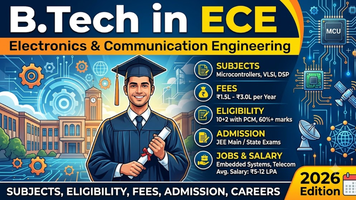
B.Tech in Electronics and Communication Engineering: Subjects, Fees, Eligibility Criteria, Admission, Jobs & Salary (2026)
Kirti Chauhan
Jun 10 2026
BCA + MCA Dual Degree: Advantages, Fees, Placement Scope & All You Need to Know (2026)
Kirti Chauhan
Jun 09 2026
B.Tech in Computer Science Engineering: Course Details, Eligibility, Fees 2026, Admission & Career Scope
Kirti Chauhan
Jun 09 2026
Careers in Digital Media After BA Mass Communication in 2026
Kirti Chauhan
Jun 08 2026
BCA in Artificial Intelligence: Subjects, Eligibility, Fees 2026, Admission Process & Job Opportunities
Kirti Chauhan
Jun 08 2026
Careers After Artificial Intelligence Courses in India 2026: Top Jobs, Salary and Future Scope
Kirti Chauhan
Jun 05 2026
B.Tech in Artificial Intelligence: Course Details, Eligibility, Fees 2026 & Career Scope
Kirti Chauhan
Jun 03 2026
7 Top Colleges for M.Des (Communication Design) in India 2026
Kirti Chauhan
Jun 02 2026
Best BJMC Colleges in Noida 2026: Fees, Admission & Career Guide
Akshita Jain
Jun 01 2026
Learn More, Grow Faster
Get Updates Straight to Your Inbox!