
BJMC vs BA Journalism: Which Course is Better in 2026?
BJMC vs BA Journalism: Which Course is Better in 2026? Explore the key differences between the two courses, including eligibility, duration, subjects, fees, salary, and career opportunities. Find out about the top colleges in India offering these programmes and their future scope. This guide will help students choose the right course based on their interests and career goals.Choosing the right undergraduate course is an important step for students who want to build a career in journalism, media, or communication. Two popular options are Bachelor of Journalism and Mass Communication (BJMC) and Bachelor of Arts in Journalism (BA Journalism). Although both programmes prepare students for careers in the media industry, they differ in their course structure, subject coverage, practical training, and career opportunities.
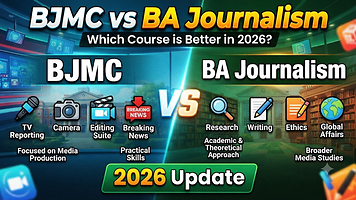
BJMC generally focuses on journalism, mass communication, digital media, advertising, public relations, and other areas of the media industry. BA Journalism places greater emphasis on news reporting, writing, editing, media ethics, and journalistic practices, although the curriculum varies by university.
In this article, students can explore the differences between BJMC and BA Journalism in 2026, including eligibility, course duration, subjects, fees, career options, salary prospects, and future scope. This comparison can help students decide which programme better matches their interests and career goals.
What Is BJMC?
Bachelor of Journalism and Mass Communication (BJMC) is an undergraduate degree that introduces students to journalism, mass communication, and different forms of media. The programme combines theoretical learning with practical activities to help students understand how news and information are produced and communicated to audiences.
The curriculum may include print journalism, television journalism, radio production, digital journalism, advertising, public relations, photography, video editing, and media research. Students may also participate in newsroom simulations, reporting assignments, fieldwork, internships, and multimedia projects, depending on the university.
BJMC can be a suitable option for students who want to explore different areas of the media industry before choosing a specialisation.
Key Highlights of BJMC
- Course duration: Generally 3 years, although some universities offer a 4-year honours programme.
- Eligibility: Usually Class 12 from a recognised board, with minimum marks determined by the university.
- Course focus: Journalism, mass communication, digital media, broadcasting, advertising, and public relations.
- Learning approach: A combination of classroom teaching, practical assignments, media production, and internships.
- Career opportunities: Reporter, news writer, content writer, video producer, social media executive, and public relations executive.
What Is BA Journalism?
Bachelor of Arts in Journalism is an undergraduate degree that focuses on the principles and practices of journalism. It helps students develop the skills required to collect information, verify facts, write news reports, conduct interviews, and communicate important developments to the public.
The programme typically covers news reporting, editing, feature writing, media laws, journalism ethics, political reporting, and the role of media in society. Depending on the institution, students may also study digital journalism, multimedia storytelling, photojournalism, and broadcast reporting.
BA Journalism may be a good choice for students who are particularly interested in news, current affairs, investigative reporting, and editorial work.
Key Highlights of BA Journalism
- Course duration: Generally 3 years, with some institutions offering 4-year undergraduate programmes.
- Eligibility: Usually Class 12 from a recognised board, subject to the university's admission requirements.
- Course focus: News reporting, editing, journalistic writing, media ethics, and news analysis.
- Learning approach: Reporting exercises, writing assignments, interviews, research, and newsroom practice.
- Career opportunities: Journalist, reporter, sub-editor, news researcher, feature writer, and digital journalist.
BJMC vs BA Journalism: Key Differences in 2026
BJMC and BA Journalism share several subjects, but their broader academic focus can differ. BJMC usually introduces students to multiple media and communication fields, while BA Journalism generally concentrates more closely on journalism and news production.
| Comparison Factor | BJMC | BA Journalism |
| Full form | Bachelor of Journalism and Mass Communication | Bachelor of Arts in Journalism |
| Course duration | Usually 3 years; some 4-year options | Usually 3 years; some 4-year options |
| Main focus | Journalism and mass communication | Journalism and news reporting |
| Course structure | Often includes journalism, advertising, PR, and media production | Often emphasises reporting, editing, and journalistic writing |
| Practical training | May include print, television, radio, and digital media projects | May include reporting, interviews, editing, and newsroom assignments |
| Career flexibility | Suitable for several media and communication roles | Particularly relevant to reporting and editorial roles |
| Eligibility | Class 12, as per university criteria | Class 12, as per university criteria |
| Fees | Vary by institution | Vary by institution |
| Higher studies | MA Journalism, MA Mass Communication, postgraduate media programmes | MA Journalism, MA Mass Communication, postgraduate media programmes |
Top Colleges for BJMC and BA Journalism in India 2026
The following are the top colleges offering BJMC and BA Journalism courses in India in 2026.
Top Colleges for BJMC in India
| College/University | Course Offered | Location |
| Bennett University* | BA Mass Communication | Greater Noida, Uttar Pradesh |
| Amity University | Journalism and Mass Communication programmes | Noida, Uttar Pradesh |
| Chandigarh University | BA Journalism and Mass Communication | Mohali, Punjab |
| Integral University | Bachelor of Journalism and Mass Communication (BJMC) | Lucknow, Uttar Pradesh |
| Dayananda Sagar University | BA Journalism and Mass Communication | Bengaluru, Karnataka |
| Institute of Management Studies (IMS) | Journalism and Mass Communication programmes | Noida, Uttar Pradesh |
Top Colleges for BA Journalism in India
| College/University | Course Offered | Location |
| Lady Shri Ram College for Women, University of Delhi | BA (Hons.) Journalism | New Delhi |
| Bharati College, University of Delhi | BA (Hons.) Journalism | New Delhi |
| Delhi College of Arts and Commerce, University of Delhi | BA (Hons.) Journalism | New Delhi |
| Kamala Nehru College, University of Delhi | BA (Hons.) Journalism | New Delhi |
| Maharaja Agrasen College, University of Delhi | BA (Hons.) Journalism | New Delhi |
| Jindal School of Journalism and Communication, O.P. Jindal Global University | BA (Hons.) Journalism and Media Studies | Sonipat, Haryana |
BJMC vs BA Journalism: Eligibility Criteria
The eligibility requirements for both courses are generally similar. Students can usually apply after completing Class 12 from a recognised board. However, the minimum marks, entrance examinations, and selection process vary across institutions.
BJMC Eligibility Criteria
Students applying for BJMC generally need to meet the following requirements:
- Pass Class 12 or an equivalent examination from a recognised board.
- Meet the minimum percentage prescribed by the university.
- Appear for an entrance examination or interview if required.
- Complete any additional admission formalities specified by the institution.
Some universities accept students from all academic streams, including Arts, Commerce, and Science.
BA Journalism Eligibility Criteria
For BA Journalism, applicants generally need to:
- Complete Class 12 from a recognised board.
- Meet the institution's minimum marks requirement.
- Qualify for an entrance test or merit-based selection process, where applicable.
- Submit the required academic documents during admission.
Students should check the official admission guidelines for the 2026 academic session before applying, as eligibility conditions can differ between universities.
BJMC vs BA Journalism: Course Duration and Subjects
Both programmes generally take three years to complete under the traditional undergraduate structure. Some universities also offer four-year honours or honours with research programmes, depending on their academic framework.
The subjects covered in each course depend on the institution, but the following are common examples.
BJMC Subjects
BJMC programmes may include:
- Introduction to Journalism and Mass Communication
- Reporting and Editing
- Print Media
- Television and Radio Journalism
- Digital Media and Online Journalism
- Advertising and Public Relations
- Media Laws and Ethics
- Photography and Video Production
- Communication Theory
- Media Research
- Social Media Communication
The broader syllabus can help students explore different career paths, including journalism, content production, public relations, and digital communication.
BA Journalism Subjects
BA Journalism programmes may include:
- Fundamentals of Journalism
- News Reporting and Writing
- Editing and Proofreading
- Feature and Editorial Writing
- Media Laws and Ethics
- Political and Development Journalism
- Photojournalism
- Broadcast Journalism
- Digital Journalism
- Media History
- Research Methods in Journalism
These subjects help students understand how news is gathered, verified, written, edited, and presented across different platforms.
BJMC vs BA Journalism: Fees in 2026
The cost of studying BJMC or BA Journalism depends on the university, location, infrastructure, facilities, and course structure. Government colleges may have comparatively lower tuition fees, while private universities may charge more for specialised facilities, studio access, equipment, and practical training.
| Fee Factor | BJMC | BA Journalism |
| Government institutions | Fees may be relatively affordable | Fees may be relatively affordable |
| Private institutions | May charge higher fees for media facilities and practical training | Fees depend on the institution and programme structure |
| Additional expenses | May include studio work, equipment, projects, and internships | May include reporting projects, equipment, and field assignments |
Before applying, check the official fee structure for the 2026 admission cycle.
BJMC vs BA Journalism: Career Opportunities
Both courses can lead to careers in print, broadcast, and digital media. The main difference is the range of areas students may explore through their coursework and practical experience.
Career Options After BJMC
BJMC graduates may apply for roles across journalism, communication, media production, and digital content.
| Job Role | Main Responsibilities |
| Reporter | Covers events, interviews sources, and prepares news reports |
| Content Writer | Creates articles, website content, and digital publications |
| Sub-editor | Edits stories for accuracy, clarity, grammar, and style |
| Video Producer | Plans and coordinates video content for media platforms |
| Social Media Executive | Publishes content and manages social media communication |
| Public Relations Executive | Develops media communication and manages public relations activities |
| Advertising Executive | Supports advertising campaigns and promotional communication |
| News Researcher | Collects information and verifies facts for news programmes or publications |
Career Options After BA Journalism
BA Journalism graduates may pursue careers that focus on news gathering, writing, editing, and reporting.
| Job Role | Main Responsibilities |
| Journalist | Researches and reports on news and current affairs |
| News Reporter | Covers events and gathers information from sources |
| Copy Editor | Reviews and edits news stories before publication |
| Feature Writer | Produces detailed articles, profiles, and human-interest stories |
| News Desk Assistant | Supports newsroom coordination and story preparation |
| Digital Journalist | Creates and publishes news for websites and digital platforms |
| News Researcher | Collects background information and verifies details |
| Photojournalist | Documents news events through photographs |
BJMC vs BA Journalism: Salary in India
The salary after BJMC or BA Journalism depends on the job role, employer, city, experience, and skills of the candidate. Entry-level salaries can vary significantly between local publications, digital media companies, television news channels, agencies, and established media organisations.
The following figures are broad illustrative estimates, not guaranteed salaries or verified industry-wide averages.
| Job Role | Indicative Entry-Level Annual Salary |
| Reporter | ₹2 lakh–₹4 lakh |
| Content Writer | ₹2 lakh–₹4.5 lakh |
| Copy Editor | ₹2.5 lakh–₹5 lakh |
| Digital Journalist | ₹2.5 lakh–₹5 lakh |
| Social Media Executive | ₹2.5 lakh–₹4.5 lakh |
| Video Producer | ₹2.5 lakh–₹5 lakh |
| Public Relations Executive | ₹2.5 lakh–₹5 lakh |
Students can improve their career prospects by developing strong writing skills, learning SEO and content management systems, building multimedia portfolios, and completing internships with news organisations or digital media companies.
BJMC vs BA Journalism: Which Course Has Better Future Scope?
The future scope of both courses is connected to changes in news consumption, digital publishing, video journalism, and online communication. News organisations increasingly publish content across websites, mobile applications, social media, and video platforms.
Future Scope After BJMC
BJMC can offer a broader introduction to media and communication. Depending on the curriculum and the student's chosen electives, graduates may explore opportunities in:
- Digital news and online publishing
- Television and video production
- Advertising and brand communication
- Public relations and corporate communication
- Social media management
- Multimedia content creation
- Podcasting and other digital formats
This broader exposure may be useful for students who are interested in journalism but also want to explore related communication careers.
Future Scope After BA Journalism
BA Journalism can provide a focused foundation for students interested in news and editorial work. Potential career areas include:
- Print and digital journalism
- News reporting and editing
- Investigative and political journalism
- Broadcast journalism
- Feature and long-form writing
- Fact-checking and news research
- Data journalism and multimedia reporting
Digital journalism skills are also important for BA Journalism graduates. Learning video editing, search engine optimisation, audience analytics, and multimedia storytelling can expand the range of opportunities available to them.
Neither degree guarantees better employment or salary outcomes. Practical skills, internships, networking, and a strong portfolio can make a meaningful difference.
BJMC vs BA Journalism: Which Course Is Better for Higher Studies?
Students who want to continue their education after graduation can consider several postgraduate options. Admission requirements vary by institution, so students should check whether their undergraduate degree meets the eligibility criteria.
| Higher Study Option | Suitable Academic Interest |
| MA Journalism | News reporting, editing, and journalistic practices |
| MA Mass Communication | Journalism and broader media communication |
| MA Media Studies | Media theory, research, and the relationship between media and society |
| Postgraduate Diploma in Journalism | Practical journalism training and professional skills |
| Digital Media Courses | Online publishing, multimedia, and digital storytelling |
| Advertising and Public Relations Programmes | Brand communication, campaigns, and public relations |
Students interested in research or academic careers can also explore postgraduate research opportunities and relevant doctoral programmes after meeting the required qualifications.
BJMC vs BA Journalism: Advantages and Disadvantages
Understanding the benefits and limitations of each programme can help students choose a degree that suits their interests.
Advantages of BJMC
- Offers exposure to multiple areas of media and communication.
- May include practical training in print, broadcast, and digital media.
- Provides opportunities to explore advertising and public relations.
- Can support applications for a variety of media-related roles.
Possible limitation: Students seeking specialised journalism training should check whether the programme offers sufficient reporting, editing, and newsroom practice.
Advantages of BA Journalism
- Provides a focused foundation in news reporting and journalistic writing.
- Helps students develop research, editing, and fact-checking skills.
- Can prepare students for roles in print, broadcast, and digital journalism.
- May suit students who already know they want to work in news media.
Possible limitation: Students who want to explore advertising, public relations, or media production should review the syllabus to see how much coverage these areas receive.
How to Choose Between BJMC and BA Journalism in 2026?
The right course depends on the student's career goals, preferred learning style, and the opportunities offered by the university.
Consider the following points before making a decision:
1. Identify your career interests: If you want to explore journalism, advertising, public relations, and media production, BJMC may be worth considering. If your main interest is reporting, editing, and news writing, BA Journalism may be a better academic fit.
2. Compare the syllabus: Do not choose a programme based only on its name. Review the subjects, electives, practical assignments, and internship requirements.
3. Check practical training: Journalism requires hands-on experience. Look for opportunities to work on student publications, news reports, podcasts, videos, and digital projects.
4. Review internship opportunities: Check whether the university supports internships, newsroom exposure, industry projects, and career guidance.
5. Compare fees and facilities: Consider the total cost of the programme alongside access to media labs, studios, libraries, equipment, and other facilities.
6. Evaluate placement information: Review available placement reports and identify the roles, employers, and salary details disclosed by the institution. Avoid relying only on the highest salary figure.
7. Consider digital skills: Choose a programme that allows you to build relevant skills in digital publishing, multimedia reporting, fact-checking, and audience engagement.
Conclusion
BJMC and BA Journalism can both provide a foundation for a career in the media industry. The better option depends on the type of work a student wants to pursue and the quality of the programme offered by the university.
BJMC may be a suitable choice for students who want to explore journalism alongside advertising, public relations, digital media, and media production. BA Journalism may be more appropriate for students who want to focus on reporting, editing, news writing, and other journalistic practices.
However, the degree title alone does not determine career success. Students should compare course content, practical training, internships, faculty, facilities, and fees before making a decision. Building a portfolio of published articles, reporting assignments, videos, and digital content can also help graduates demonstrate their abilities to potential employers.
Frequently Asked Questions (FAQs)
1. Which is better, BJMC or BA Journalism in 2026?
BJMC may be better for students interested in journalism, advertising, public relations, and media production. BA Journalism may suit students who want to focus on reporting, editing, and news writing. The better choice depends on the syllabus and career goals.
2. What is the difference between BJMC and BA Journalism?
BJMC generally covers journalism and broader mass communication subjects, while BA Journalism usually focuses more closely on reporting, editing, news writing, and journalistic practices. However, course content varies by university.
3. What is the salary after BJMC and BA Journalism in India?
Entry-level salaries depend on the role, employer, location, and skills of the candidate. Some journalism and digital media roles may offer approximately ₹2 lakh to ₹5 lakh annually at entry level, although actual salaries can vary considerably.
4. Can I become a journalist after completing BJMC or BA Journalism?
Yes. Graduates of both programmes can apply for journalism roles, including reporter, news writer, copy editor, digital journalist, and news researcher. Internships, reporting experience, writing ability, and a portfolio can improve their prospects.
5. What are the career options after BJMC and BA Journalism?
Career options include reporter, journalist, copy editor, content writer, news researcher, digital journalist, video producer, and social media executive. BJMC graduates may also explore advertising and public relations, depending on their skills and course structure.
Latest Articles
BJMC vs BA Journalism: Which Course is Better in 2026?
Kirti Chauhan
Oct 09 2026
Maharashtra Government Revises MHT CET 2027 Schedule to Post-Board Exam Window
UniList Desk
Oct 09 2026
Karnataka NEET UG 2026: KEA Releases Vacant Medical Seat List After Round 3
UniList Desk
Oct 09 2026
Maharashtra CET 5-Year LLB 2026: Extended Institute Level Merit List Released
UniList Desk
Oct 09 2026
Bihar NEET UGMAC Round 3 Rank Card 2026 Released: Download Now at bceceboard.bihar.gov.in
UniList Desk
Oct 09 2026
NTA to Align JEE Main 2027 Session 2 Dates with NEET and CUET
UniList Desk
Oct 08 2026
Kerala NEET UG 2026: Round 3 Seat Allotment Results Published
UniList Desk
Oct 08 2026
KEA Extends Karnataka PGCET 2026 Counselling Deadline to October 12
UniList Desk
Oct 08 2026
JEE Main 2027 Eligibility Criteria and Exam Schedule Announced
UniList Desk
Oct 08 2026
MCC Releases NEET PG 2026 Counselling Schedule for AIQ and State Quota Seats
UniList Desk
Oct 08 2026
Learn More, Grow Faster
Get Updates Straight to Your Inbox!