
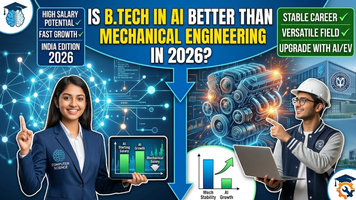
Is B.Tech in AI Better Than B.Tech in Mechanical Engineering in 2026?
Choosing between B.Tech in AI and B.Tech in Mechanical Engineering can be challenging for students after Class 12. Both courses offer good career opportunities, but they differ in subjects, skills, salary, and future scope. This article compares B.Tech AI and Mechanical Engineering in 2026 to help students make an informed decision. It also covers eligibility, career prospects, salaries, and top job roles.Choosing the right engineering course after Class 12 is an important decision. Two popular options are B.Tech in Artificial Intelligence (AI) and B.Tech in Mechanical Engineering. Both courses offer good career opportunities, but they are different in terms of subjects, skills, jobs, and future scope.
In 2026, Artificial Intelligence is growing rapidly and creating new career opportunities. At the same time, Mechanical Engineering remains one of the oldest and most respected engineering branches. Let us compare both courses to understand which one may be better for you.
What is B.Tech in Artificial Intelligence?
B.Tech in Artificial Intelligence is a four-year undergraduate engineering program that focuses on developing intelligent systems and machines. Students learn how computers can think, learn, and make decisions using data.
Main Subjects in B.Tech AI
- Artificial Intelligence
- Machine Learning
- Data Science
- Python Programming
- Deep Learning
- Robotics
- Computer Vision
- Natural Language Processing
What is B.Tech in Mechanical Engineering?
B.Tech in Mechanical Engineering is a four-year engineering course that deals with the design, manufacturing, and maintenance of machines and mechanical systems.
Main Subjects in Mechanical Engineering
- Thermodynamics
- Fluid Mechanics
- Machine Design
- Manufacturing Processes
- Engineering Mechanics
- Robotics
- Automobile Engineering
- Industrial Engineering
B.Tech AI vs B.Tech Mechanical Engineering: Quick Comparison
| Particulars | B.Tech in AI | B.Tech in Mechanical Engineering |
| Course Duration | 4 Years | 4 Years |
| Focus Area | Artificial Intelligence and Computing | Machines and Mechanical Systems |
| Skills Required | Coding, Analytics, Problem Solving | Design, Manufacturing, Technical Skills |
| Industry Demand | Very High | High |
| Average Starting Salary | ₹6–12 LPA | ₹4–8 LPA |
| Future Scope | Excellent | Good |
| Higher Studies | M.Tech AI, Data Science, MBA | M.Tech Mechanical, MBA |
| Job Opportunities | AI, IT, Robotics, Data Science | Manufacturing, Automobile, Energy |
Eligibility Criteria
The eligibility criteria for admission to both courses are as follows:
- Students must have passed Class 12 from a recognized board.
- Physics, Chemistry, and Mathematics (PCM) are compulsory subjects.
- Most universities require a minimum of 50%–60% marks.
- Admission may be based on entrance exams or merit.
Top Colleges Offering B.Tech AI and Mechanical Engineering
The table below highlights some popular universities offering both courses in India.
| University/College | B.Tech AI | B.Tech Mechanical |
| Indian Institute of Technology Delhi | ✔ | ✔ |
| Indian Institute of Technology Bombay | ✔ | ✔ |
| National Institute of Technology Trichy | ✔ | ✔ |
| Vellore Institute of Technology | ✔ | ✔ |
| SRM Institute of Science and Technology | ✔ | ✔ |
| Bennett University | ✔ | ✔ |
Career Opportunities After B.Tech AI
Graduates can work in various technology-driven industries. The table below shows some popular job roles and average starting salaries after B.Tech in AI.
| Job Role | Average Starting Salary |
| AI Engineer | ₹6–12 LPA |
| Machine Learning Engineer | ₹7–15 LPA |
| Data Scientist | ₹8–18 LPA |
| Data Analyst | ₹4–8 LPA |
| Robotics Engineer | ₹6–12 LPA |
| Software Developer | ₹5–10 LPA |
Career Opportunities After Mechanical Engineering
Mechanical Engineering graduates can find opportunities in manufacturing, automobile, aerospace, and energy sectors. The table below highlights common job roles and average starting salaries after B.Tech in Mechanical Engineering.
| Job Role | Average Starting Salary |
| Mechanical Engineer | ₹4–8 LPA |
| Design Engineer | ₹4–7 LPA |
| Production Engineer | ₹4–7 LPA |
| Automobile Engineer | ₹4–8 LPA |
| Maintenance Engineer | ₹3–6 LPA |
| Quality Engineer | ₹4–7 LPA |
Future Scope in 2026
B.Tech in AI
- Growing demand across industries.
- Opportunities in AI, Machine Learning, Robotics, and Data Science.
- Higher salary packages for skilled professionals.
- Global career opportunities.
Mechanical Engineering
- Stable career option with opportunities in core industries.
- Demand in automobile, manufacturing, aerospace, and energy sectors.
- Scope for government jobs and PSU recruitment.
- Useful for students interested in machines and design.
Which Course is Better in 2026?
The answer depends on your interests and career goals.
- Choose B.Tech in AI if you enjoy coding, technology, data, and computer-based work.
- Choose B.Tech in Mechanical Engineering if you are interested in machines, manufacturing, automobiles, and engineering design.
In terms of salary, industry demand, and future growth, B.Tech in AI has an advantage in 2026 because Artificial Intelligence is one of the fastest-growing fields worldwide. However, Mechanical Engineering remains a strong and reliable engineering branch with long-term career opportunities.
Conclusion
Both B.Tech in AI and B.Tech in Mechanical Engineering are valuable engineering degrees. B.Tech in AI offers excellent growth, higher salary potential, and strong demand in emerging technologies. Mechanical Engineering provides stable career opportunities in core engineering industries. Students should choose the course based on their interests, skills, and long-term career goals rather than following trends alone.
FAQs
1. Is B.Tech in AI better than B.Tech in Mechanical Engineering in 2026?
B.Tech in AI is considered better in 2026 for students interested in technology, coding, and data science due to its high demand, strong career growth, and higher salary potential. However, Mechanical Engineering remains a good choice for students interested in machines and manufacturing.
2. What is the average salary after B.Tech in AI?
The average starting salary after B.Tech in AI ranges from ₹6 LPA to ₹12 LPA. Roles such as AI Engineer, Machine Learning Engineer, and Data Scientist often offer higher salary packages.
3. What is the career scope of B.Tech in Mechanical Engineering?
The career scope of B.Tech in Mechanical Engineering includes opportunities in automobile, manufacturing, aerospace, energy, and industrial sectors. Graduates can work as Mechanical Engineers, Design Engineers, and Production Engineers.
4. Which course has better job opportunities: B.Tech AI or Mechanical Engineering?
B.Tech AI currently offers better job opportunities because industries are increasingly adopting Artificial Intelligence, Machine Learning, and Data Analytics. Mechanical Engineering also offers stable career opportunities in core engineering sectors.
5. What are the eligibility criteria for B.Tech in AI and Mechanical Engineering?
The eligibility criteria for both B.Tech in AI and B.Tech in Mechanical Engineering require students to pass Class 12 with Physics, Chemistry, and Mathematics (PCM) from a recognized board. Most universities require at least 50%–60% marks.
Latest Articles
Is B.Tech in AI Better Than B.Tech in Mechanical Engineering in 2026?
Kirti Chauhan
Jun 12 2026
B.A. Journalism vs B.A. Psychology: Placement and Salary Comparison in 2026
Kirti Chauhan
Jun 12 2026
B.Tech in Mechanical Engineering: Eligibility, Fees 2026 & Future Opportunities
Kirti Chauhan
Jun 12 2026
B.Tech AI vs BCA AI: Which Course is Better After 12th?
Kirti Chauhan
Jun 11 2026
B.Sc. in Artificial Intelligence: Syllabus, Subjects, Fees 2026, Eligibility, Admission, Salary & Future Scope
Kirti Chauhan
Jun 11 2026
BBA vs B.Com: Which Course is Better for Business Careers in 2026?
Kirti Chauhan
Jun 10 2026
B.Tech in Electronics and Communication Engineering: Subjects, Fees, Eligibility Criteria, Admission, Jobs & Salary (2026)
Kirti Chauhan
Jun 10 2026
BCA + MCA Dual Degree: Advantages, Fees, Placement Scope & All You Need to Know (2026)
Kirti Chauhan
Jun 09 2026
B.Tech in Computer Science Engineering: Course Details, Eligibility, Fees 2026, Admission & Career Scope
Kirti Chauhan
Jun 09 2026
Careers in Digital Media After BA Mass Communication in 2026
Kirti Chauhan
Jun 08 2026
Learn More, Grow Faster
Get Updates Straight to Your Inbox!