
Journalism and Mass Communication vs Liberal Arts: Which Course is Better for Content Careers in 2026?
Journalism and Mass Communication vs Liberal Arts is a common confusion among students planning a career in content writing, digital media, branding, and communication. This article explains the major differences between both courses, including syllabus, skills, career opportunities, salary, and industry exposure. It also highlights the best universities offering these programs in India for 2026. Students can easily understand which course is better for content careers based on their interests and long-term goals.Today, content is everywhere—news websites, YouTube channels, OTT platforms, brand blogs, podcasts, social media reels, digital magazines, PR campaigns, newsletters, and AI-driven content platforms. Because of this booming creator economy, many students after Class 12 ask one common question: Should I choose Journalism and Mass Communication or Liberal Arts for a successful content career?
Both courses can lead to strong opportunities in writing, storytelling, media production, digital communication, research, advertising, and online publishing. However, the learning style, skill development, and career direction of these two degrees are quite different.
This article explains the complete difference between Journalism and Mass Communication vs Liberal Arts, their syllabus, skills, job roles, salary, and which course is better for content careers in 2026.
Why Content Careers Are Growing Fast in 2026
The content industry is no longer limited to newspapers and magazines. Today, companies need:
- SEO writers
- Content strategists
- Social media managers
- Video scriptwriters
- Podcast producers
- Digital journalists
- Brand storytellers
- PR executives
- Copywriters
- Research-based editors
This means students need both communication skills and creative thinking skills.
That is why these two courses—Journalism and Mass Communication and Liberal Arts—are getting major attention.
What is Journalism and Mass Communication?
Journalism and Mass Communication is a professional media-focused course that teaches students how to create, edit, present, and distribute information to the public through print, digital, broadcast, and social platforms.
The course mainly focuses on:
- News writing
- Reporting
- Anchoring
- Video production
- Podcasting
- Advertising
- Public relations
- Digital media
- Social media communication
- Media laws
- SEO content writing
- Mobile journalism
Core Skills You Learn in Journalism and Mass Communication
Students become strong in:
- News and feature writing
- Interviewing
- Video scripting
- Editing
- Camera handling
- Audio storytelling
- Social media publishing
- Public communication
- Audience analysis
- SEO and digital content planning
- Brand communication
This course is highly practical and deadline-oriented.
You learn how content works in the real world.
What is Liberal Arts?
Liberal Arts is an interdisciplinary course that gives students knowledge across humanities, social sciences, communication, psychology, economics, literature, philosophy, sociology, politics, and critical thinking.
Instead of only training students for one industry, Liberal Arts builds:
- analytical thinking
- writing depth
- creativity
- research understanding
- argument building
- multidisciplinary communication
Students can often choose majors/minors such as:
- English
- Psychology
- Sociology
- Journalism
- Media Studies
- Economics
- Political Science
- Philosophy
- Digital Humanities
Core Skills You Learn in Liberal Arts
Liberal Arts students usually become strong in:
- Long-form writing
- Critical analysis
- Idea generation
- Research
- Social understanding
- Human behaviour analysis
- Creative storytelling
- Communication theory
- Culture studies
- Debate and argumentation
This course is broad, flexible, and intellectually deep.
Journalism and Mass Communication vs Liberal Arts: Major Difference
| Basis | Journalism and Mass Communication | Liberal Arts |
| Course Nature | Professional and media industry focused | Interdisciplinary and academic + creative |
| Main Goal | Train media/content professionals | Build versatile thinkers and communicators |
| Writing Style | News, PR, scripts, ad copies, digital content | Analytical, creative, research-based writing |
| Practical Exposure | High studios, media projects, internships | Moderate to high depending on university |
| Technical Media Skills | Video, editing, podcast, newsroom tools | Limited unless chosen as specialization |
| Content Industry Readiness | Immediate job-ready | Strong for strategic/creative roles |
| Best For | Journalism, PR, digital media, reporting | Content strategy, research, publishing, storytelling |
| Career Flexibility | Media-centric | Very broad |
Which Course Gives Better Writing Skills?
This depends on what kind of writer you want to become.
Journalism and Mass Communication gives:
- fast writing ability
- headline writing
- concise storytelling
- SEO article writing
- digital publishing knowledge
- script and social media content
Liberal Arts gives:
- deep writing
- strong vocabulary
- analytical content
- long-form storytelling
- intellectual essays
- opinion and research writing
Conclusion:
If you want to write quick audience-focused digital content, Journalism is better.
If you want to write insightful thought leadership and high-value editorial content, Liberal Arts is stronger.
Which Course is Better for SEO and Digital Content Careers?
In 2026, digital content jobs demand:
- SEO understanding
- content planning
- social media storytelling
- audience behaviour
- brand narrative
- multimedia content
Journalism and Mass Communication has an edge because students learn:
- online publishing
- mobile journalism
- media trends
- digital campaigns
- newsroom content speed
Many modern media schools now include SEO writing, influencer campaigns, AI tools, and digital marketing in the curriculum.
So for immediate SEO writing, digital publishing, news portals, YouTube scriptwriting, PR content, Journalism is highly effective.
Which Course is Better for Creative Brand Storytelling?
Modern brands do not just need articles.
They need:
- emotional storytelling
- campaign ideas
- consumer psychology
- narrative building
- social issue understanding
- audience connection
This is where Liberal Arts students perform strongly because they understand:
- human behaviour
- culture
- philosophy
- social context
- psychology of communication
That makes them good for:
- brand content strategy
- copywriting
- editorial storytelling
- publishing
- script development
- thought leadership content
Best Universities in India Offering Journalism, Mass Communication and Liberal Arts Programs for Content Careers
Students choosing between these two courses should also compare universities based on curriculum, practical exposure, media labs, internships, interdisciplinary learning, and content industry readiness. Some universities are known for strong journalism and digital media training, while others stand out for research-based Liberal Arts education.
| University Name | Program Offered | Why It Stands Out for Content Careers |
| Bennett University | B.A. Journalism and Mass Communication, B.A. Liberal Arts | Offers both media-focused and interdisciplinary communication programs with digital publishing labs, newsroom practice, writing modules, and industry-linked exposure. |
| Symbiosis Institute of Media and Communication, Pune | Mass Communication and Media Studies | Known for practical media education, strong communication training, production studios, and advertising-PR exposure. |
| Christ University, Bengaluru | Media Studies, Liberal Arts, English and Communication | Popular for balanced academic rigor, communication research, media studies, and strong writing-oriented humanities curriculum. |
| Ashoka University | Liberal Arts and Media Studies | One of the leading Liberal Arts institutions for analytical writing, research storytelling, public discourse, and creative communication careers. |
| FLAME University | Liberal Education, Communication Studies | Focuses on multidisciplinary storytelling, creative writing, psychology, branding, and audience behaviour understanding. |
| Manipal Institute of Communication | Media and Communication Programs | Strong in journalism, audio-visual communication, production work, and practical newsroom assignments. |
| NMIMS School of Liberal Arts | Liberal Arts and Communication | Offers flexible humanities-based communication education with writing, branding, sociology, and content strategy scope. |
| Lady Shri Ram College, Delhi University | B.A. Journalism | One of the most reputed traditional journalism colleges for editorial writing, reporting, and media credibility. |
Journalism and Mass Communication vs Liberal Arts: Career Opportunities in Content Field
After Journalism and Mass Communication
You can become:
- Digital Journalist
- News Writer
- SEO Content Writer
- Video Producer
- Social Media Executive
- PR Associate
- Broadcast Content Producer
- Anchor
- Podcast Producer
- Media Planner
- Advertising Executive
After Liberal Arts
You can become:
- Editorial Writer
- Content Strategist
- Research Writer
- Copywriter
- Publishing Editor
- Brand Storyteller
- Policy Content Analyst
- UX Writer
- Communication Researcher
- Scriptwriter
Salary Comparison in 2026
| Job Role | Avg Starting Salary |
| SEO Content Writer | ₹3 LPA – ₹5 LPA |
| Digital Journalist | ₹3.5 LPA – ₹6 LPA |
| PR Executive | ₹4 LPA – ₹6 LPA |
| Social Media Content Executive | ₹3 LPA – ₹5.5 LPA |
| Content Strategist | ₹4 LPA – ₹7 LPA |
| Editorial Research Writer | ₹4 LPA – ₹6.5 LPA |
| Copywriter | ₹4 LPA – ₹8 LPA |
Which Course Has Better Industry Exposure?
Journalism and Mass Communication usually offers:
- media labs
- newsroom simulations
- radio/video studios
- live assignments
- internships in channels/agencies
Liberal Arts offers strong classroom exploration, interdisciplinary projects, and research-based assignments, but practical exposure depends on how the university structures the program.
So if your goal is hands-on content production from Year 1, Journalism wins.
Which Course is Better for Long-Term Growth?
This is important.
Journalism and Mass Communication gives faster entry into jobs.
You can start earning quickly in:
- media portals
- PR agencies
- social media firms
- production houses
- digital magazines
Liberal Arts gives wider long-term flexibility.
You can shift later into:
- publishing
- branding
- research communication
- civil services
- policy writing
- academia
- psychology content
- communication consulting
Final Verdict: Which Course is Better for Content Careers?
Choose Journalism and Mass Communication if:
- you want immediate media industry exposure
- you enjoy reporting, reels, videos, podcasts, digital writing
- you want practical content creation
- you want newsroom and brand communication training
Choose Liberal Arts if:
- you enjoy reading, analysing, researching and writing deeply
- you want broad creative freedom
- you want strategic storytelling careers
- you want stronger intellectual writing ability
The Smart Truth in 2026
There is no single winner.
Because the content industry now wants both speed and substance.
The best universities are now blending:
- practical media learning
- digital communication
- critical thinking
- interdisciplinary writing
FAQs
1. Which is better Journalism and Mass Communication or Liberal Arts for content careers?
Journalism and Mass Communication is better for students who want practical media writing, digital journalism, PR, and social media content jobs, while Liberal Arts is better for research writing, editorial content, creative storytelling, and strategic communication careers.
2. What is the difference between Journalism and Mass Communication vs Liberal Arts?
The main difference between Journalism and Mass Communication vs Liberal Arts is that Journalism focuses on media production, reporting, digital publishing, and communication skills, whereas Liberal Arts focuses on critical thinking, interdisciplinary learning, research, and analytical writing.
3. Which universities offer Journalism and Mass Communication and Liberal Arts in India?
Some of the best universities offering Journalism and Mass Communication and Liberal Arts in India include Bennett University, Ashoka University, Christ University, Symbiosis Institute of Media and Communication, FLAME University, and NMIMS.
4. Is Liberal Arts good for content writing and digital storytelling careers?
Yes, Liberal Arts is a strong course for students interested in content writing, publishing, brand storytelling, copywriting, communication strategy, and long-form editorial writing because it builds research and analytical thinking.
5. Does Journalism and Mass Communication have better placements than Liberal Arts?
Journalism and Mass Communication often offers faster placements in digital media houses, PR agencies, social media firms, and news platforms, while Liberal Arts offers broad placement opportunities in publishing, branding, research, and communication strategy roles.
Latest Articles
Top BA (Hons.) Colleges in India 2026: Courses, Fees & Admission Process
UniList Desk
Apr 27 2026
8 Top Colleges for B.A. (Hons.) Political Science & International Relations in Delhi NCR 2026: Fees, Eligibility, Admission Process & Placements
Kirti Chauhan
Apr 27 2026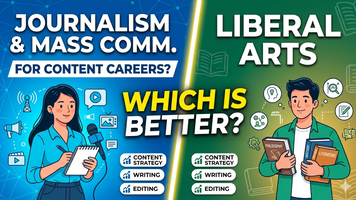
Journalism and Mass Communication vs Liberal Arts: Which Course is Better for Content Careers in 2026?
Kirti Chauhan
Apr 27 2026
Best Pharmacy Colleges in Mumbai 2026: Courses, Fees & Placements
UniList Desk
Apr 27 2026
Top Data Science Courses in India 2026: Fees, Duration & Job Opportunities
UniList Desk
Apr 26 2026
Top Government BCA Colleges in India 2026: Fees, Admission & Placements
UniList Desk
Apr 25 2026
Top Law Colleges in Lucknow 2026: Admission, Fees & Placements
UniList Desk
Apr 24 2026
Top Animation Courses in India 2026: Fees, Duration & Career Scope
UniList Desk
Apr 24 2026
Top B.Sc Colleges in Banglore 2026: Courses, Fees & Admission
UniList Desk
Apr 24 2026
BBA LL.B. vs B.A. LL.B.: Difference, Scope, Career Options and Best Colleges (2026)
Kirti Chauhan
Apr 24 2026
Learn More, Grow Faster
Get Updates Straight to Your Inbox!