
M.A. in Mass Communication: Fees, Eligibility, Admission, Placements and Future Scope 2026
M.A. (Mass Communication) is a two-year postgraduate course for students who want to build a career in journalism, digital media, advertising, public relations, television, radio, and content creation. The course teaches students how to create, manage, and share information through different media platforms. Graduates can find job opportunities in media houses, digital companies, advertising agencies, and corporate communication teams.What is M.A. (Mass Communication)?
M.A. (Mass Communication) is a postgraduate degree that focuses on media, communication, journalism, public relations, advertising, digital marketing, filmmaking, and broadcasting. The course helps students understand how news, information, and entertainment are produced and delivered to audiences.
Students also learn practical skills like news writing, video editing, reporting, content creation, media ethics, communication research, photography, podcasting, and social media management.
M.A. (Mass Communication): Highlights
| Particulars | Details |
| Course Name | M.A. (Mass Communication) |
| Course Level | Postgraduate |
| Course Duration | 2 Years |
| Eligibility | Bachelor's degree from a recognized university |
| Admission Process | Merit-based or Entrance Exam |
| Average Fees | Rs 30,000 to Rs 3 lakh (entire course) |
| Top Recruiters | Media houses, TV channels, newspapers, digital media companies, advertising agencies, PR firms |
| Average Salary | Rs 3 LPA to Rs 8 LPA |
M.A. (Mass Communication) Eligibility Criteria
Students must meet the following eligibility requirements:
- Must have completed a bachelor's degree from a recognized university.
- Minimum 50% marks are required in many universities (may vary).
- Students from any stream such as Arts, Commerce, Science, Engineering, or Management can apply.
- Final-year undergraduate students can also apply in many institutions.
M.A. (Mass Communication) Admission Process 2026
Admission generally takes place through either merit or entrance examinations.
Step 1: Check Eligibility
Ensure you meet the minimum academic requirements.
Step 2: Fill the Application Form
Apply online through the university's official admission portal.
Step 3: Entrance Exam (If Applicable)
Some universities conduct entrance exams followed by interviews or group discussions.
Step 4: Merit List
Universities release merit lists based on entrance scores or graduation marks.
Step 5: Document Verification
Submit educational certificates, identity proof, photographs, and other required documents.
Step 6: Fee Payment
Pay the admission fee to confirm your seat.
M.A. (Mass Communication) Entrance Exams 2026
Some popular entrance exams include:
- CUET PG
- Jamia Entrance Test
- IIMC Entrance (if applicable)
- University-specific entrance exams
M.A. (Mass Communication) Course Fees
The course fee depends on the college.
| College Type | Average Fees |
| Government Colleges | Rs 30,000 – Rs 1 lakh |
| Private Colleges | Rs 1 lakh – Rs 3 lakh |
M.A. (Mass Communication) Subjects
The curriculum may differ slightly across universities, but common subjects include:
First Year
- Introduction to Mass Communication
- Print Journalism
- Broadcast Journalism
- Media Laws and Ethics
- Communication Theory
- Reporting and Editing
- Photography
- Digital Media
Second Year
- Public Relations
- Advertising
- Film Studies
- Media Research
- Social Media Management
- Content Writing
- Television Production
- Internship
- Dissertation or Project Work
Skills Required for M.A. (Mass Communication)
Students should develop the following skills:
- Communication skills
- Writing and editing
- Creativity
- Presentation skills
- Public speaking
- Research skills
- Critical thinking
- Social media management
- Video editing
- Time management
M.A. (Mass Communication) Placements
Many universities provide placement support through campus recruitment and internships.
Top Recruiters
- News channels
- Newspapers
- Digital media companies
- Advertising agencies
- Public Relations firms
- Radio stations
- Film production houses
- OTT platforms
- Corporate communication departments
- Social media agencies
Average Salary
| Experience | Average Salary |
| Freshers | Rs 3 LPA – Rs 5 LPA |
| 2–5 Years | Rs 5 LPA – Rs 8 LPA |
| Experienced Professionals | Rs 8 LPA – Rs 15 LPA+ |
Career Opportunities After M.A. (Mass Communication)
Graduates can work in different sectors of media and communication.
Popular job roles include:
- Journalist
- News Reporter
- News Anchor
- Content Writer
- Copywriter
- Digital Marketing Executive
- Social Media Manager
- Public Relations Officer
- Media Planner
- Advertising Executive
- Television Producer
- Radio Jockey
- Video Producer
- Film Researcher
- Communication Consultant
- Corporate Communication Executive
Future Scope of M.A. (Mass Communication)
The demand for media professionals is increasing because businesses, news organizations, and digital platforms need skilled communicators.
After completing the course, students can:
- Work in television, newspapers, radio, or digital media.
- Join advertising and public relations agencies.
- Build a career in digital marketing and content creation.
- Become a YouTuber, podcaster, or social media influencer.
- Work in corporate communication departments.
- Prepare for government communication and information services.
- Pursue higher studies like M.Phil., Ph.D., or specialized media certifications.
Top Colleges Offering M.A. (Mass Communication)
Some well-known institutions include:
- Indian Institute of Mass Communication (IIMC)
- Jamia Millia Islamia
- Symbiosis Institute of Media and Communication
- Christ University
- Amity University
- Guru Gobind Singh Indraprastha University
- Banaras Hindu University
- University of Hyderabad
Why Choose M.A. (Mass Communication)?
- Wide range of career opportunities
- High demand in digital media
- Opportunity to work in television, print, and online media
- Creative and dynamic profession
- Good salary growth with experience
- Scope to work independently as a content creator or media consultant
Conclusion
M.A. (Mass Communication) is an excellent postgraduate course for students interested in journalism, media, advertising, digital communication, and public relations. The programme combines theoretical knowledge with practical training, helping graduates build successful careers in the fast-growing media industry. With the rapid growth of digital platforms and content-based businesses, the future scope of this course continues to expand.
FAQs
1. What is the duration of an M.A. (Mass Communication)?
The course duration is 2 years.
2. Who can apply for M.A. (Mass Communication)?
Students with a bachelor's degree from a recognized university can apply.
3. What is the average fee for M.A. (Mass Communication)?
The average course fee ranges from Rs 30,000 to Rs 3 lakh, depending on the college.
4. What is the average salary after M.A. (Mass Communication)?
Fresh graduates can earn around Rs 3 LPA to Rs 5 LPA, while experienced professionals can earn significantly more.
5. What are the best career options after M.A. (Mass Communication)?
Graduates can work as journalists, content writers, PR executives, digital marketers, social media managers, news anchors, advertising professionals, and corporate communication executives.
Latest Articles

Notification for Telangana NEET Counselling 2026 Released on @knruhs.telangana.gov.in; Important Dates and Required Documents
UniList Desk
Aug 04 2026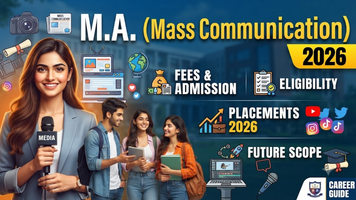
M.A. in Mass Communication: Fees, Eligibility, Admission, Placements and Future Scope 2026
Kirti Chauhan
Aug 04 2026
Telangana NEET UG Counseling 2026: Registration Opens Tomorrow; Learn About Cutoff, Required Documents, and Procedures
UniList Desk
Aug 04 2026
Documents Needed for MCC NEET UG Counselling 2026 Registration: Prepare Your Certificates
UniList Desk
Aug 04 2026
Kerala NEET Counseling 2026: CEE Launches Application Correction Option; Deadline is August 10
UniList Desk
Aug 04 2026
NEET SS Counseling 2025: Updated Timeline for Round 2 Released; Review Choice Submission and Seat Allocation Results
UniList Desk
Aug 04 2026
HBSE 10th and 12th Compartment Results for 2026 to be Announced Shortly; Anticipate the Release Date for HBSE Supplementary Results
UniList Desk
Aug 04 2026
Registration for Phase 3 of AUEET 2026 Counseling Begins; Allocations Scheduled for August 10
UniList Desk
Aug 04 2026
MP NEET UG Counseling 2026 Timeline PDF Made Available; Review Key Dates for MBBS and BDS Enrollment
UniList Desk
Aug 04 2026
Revised Schedule for TS PGLCET 2026 Counseling Announced; Verify Final Date for TG PGLCET Counseling Registration
UniList Desk
Aug 04 2026
Learn More, Grow Faster
Get Updates Straight to Your Inbox!