
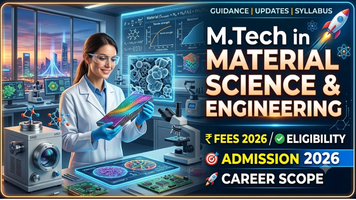
M.Tech (Material Science & Engineering): Fees 2026, Eligibility, Admission, Career Scope
M.Tech in Material Science & Engineering is a 2-year postgraduate course that focuses on advanced materials, nanotechnology, metallurgy, and material design. The programme offers excellent career opportunities in industries like aerospace, automotive, semiconductor, defence, and manufacturing. This article covers M.Tech Material Science & Engineering fees 2026, eligibility, admission process, top colleges, syllabus, salary, and career scope in easy words. Read on to know whether this course is the right choice for your future.Material Science and Engineering is one of the fastest-growing engineering fields. It focuses on studying different materials such as metals, ceramics, polymers, semiconductors, composites, and nanomaterials. Students learn how materials are designed, tested, improved, and used in industries like aerospace, automotive, electronics, healthcare, energy, and construction.
If you are interested in research, innovation, manufacturing, or advanced technology, an M.Tech in Material Science & Engineering can be a great career choice. The course offers excellent opportunities in both India and abroad.
What is M.Tech in Material Science & Engineering?
M.Tech in Material Science & Engineering is a 2-year postgraduate engineering programme divided into four semesters. The course helps students understand the structure, properties, processing, and applications of different materials. Students also work on laboratory experiments, research projects, simulations, and industry-based applications.
The programme prepares graduates for careers in research, manufacturing, product development, quality control, and advanced materials technology. Many institutes also focus on modern areas such as nanotechnology, biomaterials, energy materials, smart materials, and semiconductor materials.
M.Tech Material Science & Engineering Highlights 2026
| Particular | Details |
| Course Name | M.Tech in Material Science & Engineering |
| Course Level | Postgraduate |
| Duration | 2 Years |
| Eligibility | BE/B.Tech or equivalent in relevant discipline |
| Admission Process | GATE Score, Entrance Exam, Merit-Based, Interview (varies by college) |
| Course Fees | Rs 40,000 to Rs 5 lakh (entire course) |
| Average Salary | Rs 6 LPA to Rs 15 LPA |
| Top Recruiters | Tata Steel, JSW Steel, DRDO, ISRO, BHEL, Vedanta, Reliance Industries, Saint-Gobain, Intel, Samsung |
Why Choose M.Tech in Material Science & Engineering?
There are many reasons to pursue this course:
- Growing demand for materials engineers across industries.
- Excellent career opportunities in research and development.
- High demand in semiconductor and renewable energy sectors.
- Opportunity to work on advanced materials and nanotechnology.
- Good salary packages in India and abroad.
- Strong foundation for pursuing a PhD.
- Opportunities in government organizations and PSUs.
M.Tech Material Science & Engineering Eligibility Criteria 2026
Eligibility may vary from one college to another. However, the basic requirements are:
- Bachelor's degree (BE/B.Tech) in Material Science, Metallurgical Engineering, Mechanical Engineering, Chemical Engineering, Ceramic Engineering, Production Engineering, or related fields.
- Some universities also accept M.Sc. graduates in Physics, Chemistry, Materials Science, or related subjects.
- Minimum 50% to 60% marks in graduation.
- A valid GATE score is required for admission in most IITs, NITs, and government institutes, while some private universities also offer admission based on merit or their own entrance process.
M.Tech Material Science & Engineering Admission Process 2026
Admission generally follows these steps:
Step 1: Check Eligibility
Ensure you meet the educational qualification and minimum marks required.
Step 2: Appear for GATE
Most top engineering institutes accept GATE scores for admission.
Step 3: Fill the Application Form
Apply online through the college or university website.
Step 4: Selection Process
Candidates are shortlisted based on:
- GATE Score
- Academic Performance
- Written Test (if applicable)
- Personal Interview
Step 5: Document Verification
Submit all required academic documents and complete admission formalities.
M.Tech Material Science & Engineering Fees 2026
Course fees depend on the institute.
| College Type | Approximate Fees |
| Government Colleges | Rs 40,000 – Rs 2 lakh |
| NITs | Rs 1 lakh – Rs 2.5 lakh |
| IITs | Rs 1 lakh – Rs 3 lakh |
| Private Universities | Rs 2 lakh – Rs 5 lakh |
M.Tech Material Science & Engineering Subjects
Some common subjects include:
- Physical Metallurgy
- Advanced Materials Engineering
- Nanomaterials
- Polymer Science
- Ceramic Materials
- Composite Materials
- Electronic Materials
- Materials Characterization
- Corrosion Engineering
- Computational Materials Science
- Materials Processing
- Fracture Mechanics
- Biomaterials
- Semiconductor Materials
- Dissertation and Research Project
Skills Required
Students should develop the following skills:
- Analytical thinking
- Laboratory skills
- Problem-solving ability
- Research skills
- Data analysis
- Communication skills
- Teamwork
- Knowledge of simulation software
- Technical writing
Top M.Tech Material Science & Engineering Colleges in India
Some popular colleges include:
- IIT Delhi
- IIT Kanpur
- IIT Bombay
- IIT Madras
- IIT Kharagpur
- IIT Roorkee
- IIT Hyderabad
- NIT Trichy
- NIT Rourkela
- NIT Surathkal
- IISc Bangalore
- Bennett University
Career Scope After M.Tech Material Science & Engineering
Graduates have opportunities in many industries because every manufacturing sector depends on advanced materials.
Popular industries include:
- Aerospace
- Automotive
- Steel Industry
- Electronics
- Semiconductor Manufacturing
- Renewable Energy
- Defence
- Biomedical Engineering
- Construction
- Oil and Gas
- Nuclear Energy
- Research Laboratories
Students can also pursue a PhD, become researchers, or join international research organizations.
Job Roles After M.Tech Material Science & Engineering
Popular career options include:
- Materials Engineer
- Metallurgical Engineer
- Research Scientist
- Process Engineer
- Quality Control Engineer
- Product Development Engineer
- Nanotechnology Engineer
- Semiconductor Engineer
- Corrosion Engineer
- Manufacturing Engineer
- R&D Engineer
- Technical Consultant
Salary After M.Tech Material Science & Engineering
Salary depends on skills, experience, and employer.
| Experience | Average Salary |
| Freshers | Rs 6 LPA – Rs 9 LPA |
| 3–5 Years | Rs 10 LPA – Rs 15 LPA |
| Senior Professionals | Rs 18 LPA – Rs 35 LPA or more |
Top Recruiters
Some leading recruiters include:
- Tata Steel
- JSW Steel
- SAIL
- Vedanta
- Reliance Industries
- DRDO
- ISRO
- BHEL
- HAL
- Intel
- Samsung
- Saint-Gobain
- Bosch
- Siemens
- L&T
- Hindalco
Higher Study Options
After completing M.Tech, students can pursue:
- PhD in Material Science
- PhD in Nanotechnology
- PhD in Metallurgical Engineering
- MBA
- Research Fellowships
- International Research Programmes
Is M.Tech in Material Science & Engineering Worth It?
Yes. M.Tech in Material Science & Engineering is an excellent choice for students interested in research, manufacturing, semiconductor technology, renewable energy, aerospace, and advanced materials. With the increasing demand for lightweight materials, electric vehicles, clean energy, and chip manufacturing, the need for skilled materials engineers is expected to grow in the coming years. The course also offers strong opportunities in research organizations, government sectors, and multinational companies.
Conclusion
M.Tech in Material Science & Engineering is a promising postgraduate course for students who want to build a career in modern engineering and research. The programme provides in-depth knowledge of advanced materials, practical laboratory experience, and industry exposure. Graduates can find rewarding careers in manufacturing, research, aerospace, defence, healthcare, electronics, and semiconductor industries while enjoying good salary packages and long-term career growth.
FAQs
1. What is the eligibility for M.Tech Material Science & Engineering in 2026?
To apply for M.Tech Material Science & Engineering 2026, candidates must have a BE/B.Tech degree in a relevant engineering discipline with at least 50%–60% marks. Many top institutes also require a valid GATE score.
2. What are the fees for M.Tech Material Science & Engineering in India?
The M.Tech Material Science & Engineering fees 2026 generally range from Rs 40,000 to Rs 5 lakh for the complete course, depending on whether the college is government or private.
3. What is the admission process for M.Tech Material Science & Engineering?
The M.Tech Material Science & Engineering admission 2026 process is based on GATE scores, university entrance exams, merit, and personal interviews, depending on the institute.
4. What is the career scope after M.Tech Material Science & Engineering?
The career scope after M.Tech Material Science & Engineering is excellent. Graduates can work as Materials Engineers, Research Scientists, Metallurgical Engineers, Process Engineers, and R&D Engineers in industries like steel, aerospace, semiconductor, defence, and manufacturing.
5. What is the average salary after M.Tech Material Science & Engineering?
The M.Tech Material Science & Engineering salary for fresh graduates usually ranges from Rs 6 LPA to Rs 9 LPA, while experienced professionals can earn Rs 15 LPA to Rs 35 LPA or more.
Latest Articles
M.Tech (Material Science & Engineering): Fees 2026, Eligibility, Admission, Career Scope
Kirti Chauhan
Jul 16 2026
M.Tech (Biotech): Fees 2026, Eligibility Criteria, Admission, Placements and Career Options
Kirti Chauhan
Jul 15 2026
M.Tech (Computer Science Engineering): Fees, Admission, Top Colleges, Career Scope, Eligibility 2026
Kirti Chauhan
Jul 15 2026
MCA (Master of Computer Application): Fees, Eligibility, Admission 2026 – Complete Guide
Kirti Chauhan
Jul 16 2026
M.Des (Communication Design): Course Details, Fees 2026, Eligibility, Admission, Salary and Career
Kirti Chauhan
Jul 14 2026
Master of Computer Applications in Artificial Intelligence: Fees 2026, Eligibility Criteria, Admission, Career and Everything You Need to Know
Kirti Chauhan
Jul 13 2026
M.Sc. (Artificial Intelligence): Fees 2026, Eligibility Criteria, Admission, Career and All You Need to Know
Kirti Chauhan
Jul 13 2026
Can You Get B.Tech Admission Without JEE Main? Complete Guide 2026
Kirti Chauhan
Jul 10 2026
Top B.Tech Computer Science Colleges Based on Class 12 PCM Marks
Kirti Chauhan
Jul 10 2026
Best Private B.Tech Colleges You Can Get with Different JEE Main Percentiles in 2026
Kirti Chauhan
Jul 09 2026
Learn More, Grow Faster
Get Updates Straight to Your Inbox!