
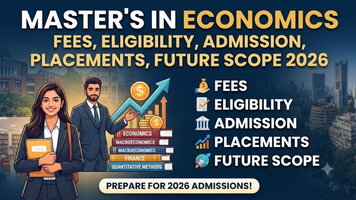
Master's in Economics: Fees, Eligibility Criteria, Admission, Placements, Future Scope 2026
A Master's in Economics is a two-year postgraduate programme that provides advanced knowledge of economic theories, finance, data analysis, and public policy. The course offers excellent career opportunities in banking, consulting, research, government organisations, and multinational companies. Learn about the eligibility, fees, admission process, placements, and future scope of a Master's in Economics in 2026.A Master's in Economics is a two-year postgraduate programme that helps students understand economic theories, financial markets, public policies, statistics, and data analysis. The course prepares students to solve real-world economic problems and make informed business and policy decisions.
With the growing demand for economists, financial analysts, policy researchers, and data professionals, a Master's in Economics has become one of the most sought-after postgraduate degrees in India. Graduates can find opportunities in government organisations, multinational companies, banks, consulting firms, research institutes, and international organisations.
This article covers the fees, eligibility criteria, admission process, syllabus, placements, salary, and future scope of a Master's in Economics in 2026.
Highlights of Master's in Economics 2026
| Particulars | Details |
| Course Name | Master's in Economics (MA/MSc Economics) |
| Course Level | Postgraduate |
| Course Duration | 2 Years |
| Admission Process | Entrance Exam or Merit-Based |
| Eligibility | Bachelor's degree with minimum qualifying marks |
| Average Fees | Rs 20,000 to Rs 5 lakh |
| Average Starting Salary | Rs 4 LPA to Rs 10 LPA |
| Top Recruiters | RBI, NITI Aayog, Deloitte, EY, KPMG, World Bank, Banks, Consulting Firms |
What is a Master's in Economics?
A Master's in Economics is designed to provide advanced knowledge of economic principles, mathematical economics, econometrics, public finance, international economics, and development economics.
The programme combines theoretical learning with practical applications through research projects, case studies, data analysis, and internships. Students develop analytical, quantitative, and problem-solving skills that are valuable across multiple industries.
Master's in Economics Eligibility Criteria 2026
The eligibility criteria may vary across universities, but the common requirements include:
- Candidates must have completed a Bachelor's degree from a recognised university.
- Most universities require at least 50% to 60% aggregate marks in graduation.
- Some institutes prefer candidates with Economics, Mathematics, Statistics, Commerce, or related backgrounds.
- Reserved category candidates may receive relaxation in qualifying marks according to government norms.
- Candidates appearing in the final year of graduation may also apply, subject to university rules.
Master's in Economics Admission Process 2026
Admissions are conducted through either entrance examinations or merit-based selection.
Step 1: Check Eligibility
Ensure you meet the minimum educational qualification and percentage required by the university.
Step 2: Fill the Application Form
Apply through the official website of the preferred university or institution.
Step 3: Entrance Examination
Some universities conduct their own entrance tests, while others accept national-level entrance exam scores.
Step 4: Merit List
Universities release merit lists based on entrance scores or graduation marks.
Step 5: Counselling and Document Verification
Shortlisted candidates attend counselling sessions and complete document verification.
Step 6: Fee Payment
After verification, candidates pay the admission fee to confirm their seat.
Entrance Exams for Master's in Economics 2026
Some popular entrance exams include:
- CUET PG
- IIT JAM (Economics)
- Delhi School of Economics Entrance Test
- JNU Entrance (subject to university admission policy)
- University-specific entrance examinations
Master's in Economics Fees 2026
The course fee depends on the institution.
| Institution Type | Average Fees |
| Government Universities | Rs 20,000 – Rs 1 lakh |
| Private Universities | Rs 1 lakh – Rs 5 lakh |
Master's in Economics Syllabus
The syllabus may vary among universities, but common subjects include:
First Year
- Microeconomic Theory
- Macroeconomic Theory
- Mathematical Economics
- Statistics for Economics
- Econometrics
- Public Economics
Second Year
- International Economics
- Development Economics
- Environmental Economics
- Financial Economics
- Industrial Economics
- Research Methodology
- Dissertation or Research Project
Skills Required for a Master's in Economics
Students should develop the following skills:
- Analytical thinking
- Mathematical ability
- Statistical analysis
- Data interpretation
- Research skills
- Problem-solving
- Communication skills
- Critical thinking
- Decision-making
- Report writing
Top Career Opportunities After a Master's in Economics
Graduates can work in several industries including finance, banking, consulting, education, research, and public policy.
Some popular job roles include:
- Economist
- Financial Analyst
- Economic Consultant
- Data Analyst
- Policy Analyst
- Investment Analyst
- Banking Professional
- Market Research Analyst
- Risk Analyst
- Business Analyst
- Research Associate
- Lecturer or Academic Researcher
Master's in Economics Placements 2026
Many universities have dedicated placement cells that connect students with leading recruiters.
The average salary generally ranges between Rs 4 LPA and Rs 10 LPA, while experienced professionals may earn significantly higher salaries depending on their role, organisation, and expertise.
Top Recruiters
- Reserve Bank of India (RBI)
- NITI Aayog
- Deloitte
- EY
- KPMG
- PwC
- ICICI Bank
- HDFC Bank
- SBI
- CRISIL
- World Bank
- Asian Development Bank
- McKinsey & Company
- Accenture
- Tata Consultancy Services (TCS)
Future Scope of a Master's in Economics
A Master's in Economics offers excellent long-term career opportunities as economies increasingly rely on data-driven decision-making.
Graduates can pursue careers in:
- Government ministries
- Public policy organisations
- Financial institutions
- International organisations
- Research institutes
- Corporate strategy teams
- Consulting firms
- Investment companies
- Universities and colleges
Students can also pursue higher education such as:
- MPhil (where available)
- PhD in Economics
- MBA
- Public Policy programmes
- International Economics specialisations
Professionals with expertise in econometrics, data analytics, artificial intelligence, and financial modelling are expected to remain in high demand in the coming years.
Why Choose a Master's in Economics?
Some major benefits of pursuing this course include:
- Strong career opportunities across industries
- High demand in banking, finance, and consulting
- Excellent analytical and quantitative skill development
- Opportunities in government and international organisations
- Competitive salary packages
- Pathway to research and doctoral studies
- Global career prospects
Conclusion
A Master's in Economics is an excellent choice for students interested in understanding economic systems, financial markets, and public policy. The programme equips graduates with analytical, research, and data-driven decision-making skills that are highly valued across industries. With increasing opportunities in banking, consulting, government organisations, research institutions, and multinational companies, pursuing a Master's in Economics in 2026 can lead to a rewarding and future-ready career.
FAQs
1. What is the duration of a Master's in Economics course?
A Master's in Economics is generally a 2-year postgraduate programme divided into four semesters.
2. What is the eligibility for admission to a Master's in Economics in 2026?
Candidates must have a Bachelor's degree from a recognised university with at least 50%–60% marks, depending on the institute.
3. What is the average fee for a Master's in Economics?
The course fee typically ranges from Rs 20,000 to Rs 5 lakh, depending on whether the institution is government or private.
4. What are the career options after completing a Master's in Economics?
Graduates can work as Economists, Financial Analysts, Policy Analysts, Data Analysts, Economic Consultants, Researchers, and Banking Professionals.
5. What is the average salary after a Master's in Economics?
Fresh graduates can expect an average salary of Rs 4 LPA to Rs 10 LPA, depending on their skills, job role, and employer.
Latest Articles
Master's in Economics: Fees, Eligibility Criteria, Admission, Placements, Future Scope 2026
Kirti Chauhan
Aug 07 2026
CBSE 12th Compartment Results for 2026 Set to Be Announced Shortly; Verify Required Passing Scores
UniList Desk
Aug 07 2026
Admissions for JNU DOP 2026 Now Open: Review Key Dates and Online Application Process
UniList Desk
Aug 07 2026
BSE Odisha is set to announce the 10th Supplementary Results for 2026 shortly; find out the passing marks and anticipated outcomes.
UniList Desk
Aug 07 2026
Mumbai University Extends Registration Deadline for UG and PG Admissions 2026; Applications Now Open on Samarth Portal
UniList Desk
Aug 07 2026
Deadline for AILET 2027 Registration Announced; NLU Delhi Reveals Date for Admit Card Availability
UniList Desk
Aug 07 2026
TS EDCET Counseling 2026: Online Choice Submission Starts Today; Seat Assignments
UniList Desk
Aug 07 2026
NIFT has announced the 2026 PhD schedule, available at nift.ac.in/admission.
UniList Desk
Aug 07 2026
15th Convocation at IIT Ropar: 761 Students Earn Degrees, Undergraduate Curriculum Overhauled
UniList Desk
Aug 07 2026
Tentative Allotment for TNEA 2026 Round 2 Released; Upcoming Counseling Dates Announced
UniList Desk
Aug 07 2026
Learn More, Grow Faster
Get Updates Straight to Your Inbox!