
MBA: Fees 2026, Eligibility Criteria, Admission, Placements, Syllabus, Career Scope and Everything You Need to Know
An MBA is one of the most popular postgraduate management programmes that prepares students for leadership roles across industries. This guide covers MBA fees 2026, eligibility criteria, admission process, entrance exams, syllabus, specialisations, placements, salary, and career opportunities. It also highlights top recruiters, popular MBA colleges, and the skills required to build a successful management career. Read on to discover everything you need to know before applying for an MBA in 2026.An MBA (Master of Business Administration) is one of the most sought-after postgraduate degrees for students and working professionals who want to build a successful career in business, management, finance, marketing, consulting, or entrepreneurship. The programme equips students with leadership, analytical, communication, and strategic decision-making skills that are highly valued across industries.
Whether you are a fresh graduate or a professional looking to accelerate your career, an MBA can open doors to higher-paying job roles and leadership opportunities. This guide covers everything you need to know about MBA fees, eligibility criteria, admission process, entrance exams, syllabus, specialisations, placements, salary, and career opportunities in 2026.
What is an MBA?
A Master of Business Administration (MBA) is a two-year postgraduate programme designed to develop managerial and leadership skills. The course combines theoretical knowledge with practical business applications through case studies, internships, live projects, and industry interactions.
MBA programmes are offered in multiple formats, including:
- Full-Time MBA
- Part-Time MBA
- Executive MBA (EMBA)
- Online MBA
- Distance MBA
- Integrated MBA
MBA Course Highlights
| Particulars | Details |
| Course Name | Master of Business Administration (MBA) |
| Course Level | Postgraduate |
| Duration | 2 Years |
| Eligibility | Bachelor's degree with minimum 50% marks (45% for reserved categories in many institutes) |
| Admission | Entrance Exam and Merit-Based |
| Top Entrance Exams | CAT, XAT, MAT, CMAT, NMAT, SNAP, ATMA, GMAT |
| Average Course Fees | Rs 2 lakh to Rs 30 lakh |
| Average Salary | Rs 6 LPA to Rs 20 LPA |
| Top Recruiters | Deloitte, Accenture, Amazon, TCS, EY, KPMG, PwC, Infosys, HDFC Bank, ICICI Bank |
Why Choose an MBA?
Pursuing an MBA offers several advantages, including:
- Develops leadership and management skills
- Higher salary potential
- Better career growth opportunities
- Networking with industry professionals
- Opportunities in India and abroad
- Entrepreneurship and business management skills
- Diverse career options across industries
MBA Eligibility Criteria 2026
The eligibility criteria may vary across institutes, but the general requirements include:
- Bachelor's degree from a recognised university.
- Minimum 50% aggregate marks.
- Reserved category candidates often require 45% marks.
- Final-year graduation students can also apply.
- Some institutes require valid entrance exam scores.
- Work experience is preferred for Executive MBA programmes.
MBA Admission Process 2026
Admission to MBA programmes generally involves multiple stages.
Step 1: Meet Eligibility
Ensure you fulfil the academic requirements of the chosen institute.
Step 2: Appear for Entrance Exam
Candidates need to qualify in one of the accepted management entrance examinations.
Step 3: Application Process
Apply to the preferred colleges after the entrance exam results are announced.
Step 4: Shortlisting
Institutes shortlist candidates based on:
- Entrance exam score
- Academic performance
- Work experience (if applicable)
Step 5: Selection Process
Shortlisted candidates may undergo:
- Group Discussion (GD)
- Personal Interview (PI)
- Written Ability Test (WAT)
Step 6: Final Admission
Admission is confirmed after document verification and fee payment.
MBA Entrance Exams 2026
Several national and institute-level entrance exams are accepted for MBA admissions.
| Entrance Exam | Conducting Body |
| CAT | Indian Institutes of Management |
| XAT | XLRI Jamshedpur |
| MAT | AIMA |
| CMAT | National Testing Agency |
| NMAT | GMAC |
| SNAP | Symbiosis International University |
| ATMA | AIMS |
| GMAT | Graduate Management Admission Council |
MBA Course Fees 2026
MBA fees vary significantly depending on the institution.
| Institute Type | Average Fees |
| Government Colleges | Rs 50,000 to Rs 5 lakh |
| State Universities | Rs 1 lakh to Rs 6 lakh |
| Private Universities | Rs 5 lakh to Rs 30 lakh |
| IIMs | Rs 20 lakh to Rs 35 lakh |
MBA Specialisations
Students can choose from a wide range of MBA specialisations based on their interests and career goals.
Popular MBA specialisations include:
- Finance
- Marketing
- Human Resource Management
- Operations Management
- Business Analytics
- Information Technology
- Healthcare Management
- International Business
- Supply Chain Management
- Digital Marketing
- Entrepreneurship
- Retail Management
- Hospitality Management
- Banking and Finance
- Data Analytics
- Artificial Intelligence
- Project Management
MBA Syllabus
The curriculum is generally divided across four semesters.
First Year Subjects
- Principles of Management
- Financial Accounting
- Managerial Economics
- Marketing Management
- Business Statistics
- Organizational Behaviour
- Human Resource Management
- Business Communication
Second Year Subjects
- Financial Management
- Operations Management
- Strategic Management
- Business Analytics
- Entrepreneurship
- International Business
- Elective Subjects
- Summer Internship Project
- Capstone Project
Skills Required for MBA
Students pursuing an MBA should develop:
- Leadership skills
- Communication skills
- Analytical thinking
- Decision-making ability
- Problem-solving skills
- Teamwork
- Time management
- Presentation skills
- Business acumen
Top MBA Colleges in India
Some of the leading MBA institutions include:
- Indian Institutes of Management (IIMs)
- XLRI Jamshedpur
- Faculty of Management Studies (FMS), Delhi
- Management Development Institute (MDI), Gurugram
- SP Jain Institute of Management and Research (SPJIMR), Mumbai
- Indian School of Business (ISB), Hyderabad
- Symbiosis Institute of Business Management (SIBM), Pune
- Narsee Monjee Institute of Management Studies (NMIMS), Mumbai
- Institute of Management Technology (IMT), Ghaziabad
- Bennett University, Greater Noida
MBA Placements
MBA graduates are recruited by companies across sectors including consulting, banking, finance, FMCG, IT, healthcare, manufacturing, and e-commerce.
Common recruiters include:
- Deloitte
- Accenture
- EY
- KPMG
- PwC
- Amazon
- Microsoft
- Infosys
- TCS
- Wipro
- HDFC Bank
- ICICI Bank
- Reliance Industries
MBA Salary in India
Salary depends on the institute, specialization, skills, and work experience.
| Job Role | Average Salary |
| Marketing Manager | Rs 8 LPA to Rs 18 LPA |
| Financial Analyst | Rs 6 LPA to Rs 15 LPA |
| HR Manager | Rs 7 LPA to Rs 16 LPA |
| Business Analyst | Rs 8 LPA to Rs 20 LPA |
| Operations Manager | Rs 8 LPA to Rs 18 LPA |
| Product Manager | Rs 15 LPA to Rs 35 LPA |
| Management Consultant | Rs 12 LPA to Rs 30 LPA |
| Investment Banker | Rs 15 LPA to Rs 40 LPA |
Career Opportunities After MBA
MBA graduates can work across various industries.
Popular career options include:
- Business Analyst
- Marketing Manager
- HR Manager
- Financial Analyst
- Operations Manager
- Product Manager
- Sales Manager
- Management Consultant
- Investment Banker
- Project Manager
- Brand Manager
- Entrepreneur
Industries Hiring MBA Graduates
MBA graduates find employment in:
- Banking and Financial Services
- Information Technology
- Consulting
- Healthcare
- FMCG
- Retail
- Manufacturing
- Telecommunications
- E-commerce
- Media and Entertainment
- Logistics and Supply Chain
Is an MBA Worth It?
An MBA can be a valuable investment for individuals looking to build leadership careers, switch industries, start their own businesses, or secure higher-paying management roles. Choosing the right college, specialization, and gaining practical experience through internships significantly enhances career prospects and return on investment.
Conclusion
An MBA remains one of the most versatile postgraduate programmes in India and globally. With multiple specialisations, excellent placement opportunities, and strong salary potential, it continues to be a preferred choice among graduates. Before applying, compare colleges based on accreditation, curriculum, faculty, placement records, industry exposure, and fee structure to make an informed decision. A well-planned MBA journey can lead to rewarding careers across diverse industries and leadership positions.
Frequently Asked Questions (FAQs)
1. What is the eligibility criteria for MBA admission in 2026?
Candidates must have a bachelor's degree from a recognised university with at least 50% aggregate marks. Most colleges also require a valid score in entrance exams such as CAT, XAT, MAT, CMAT, or NMAT.
2. What are the average MBA fees in India?
MBA fees generally range from Rs 50,000 to Rs 35 lakh, depending on whether the institute is government-funded, private, or an IIM.
3. Which MBA specialisation offers the highest salary?
MBA specialisations such as Finance, Business Analytics, Product Management, Consulting, Artificial Intelligence, and Marketing often offer some of the highest salary packages.
4. What are the top entrance exams for MBA admission?
Popular MBA entrance exams include CAT, XAT, MAT, CMAT, NMAT, SNAP, ATMA, and GMAT.
5. What are the placement opportunities after an MBA?
MBA graduates are hired by leading companies in consulting, finance, IT, e-commerce, healthcare, manufacturing, and FMCG sectors, with average salaries ranging from Rs 6 LPA to Rs 20 LPA, depending on the institute and job role.
Latest Articles

MBA in Business Analytics: Fees, Eligibility Criteria, Admission, Placements and Career Scope 2026
Kirti Chauhan
Jul 21 2026
MBA in Marketing: Fees 2026, Eligibility Criteria, Admission, Placements, Career Scope and Salary
Kirti Chauhan
Jul 20 2026
MBA: Fees 2026, Eligibility Criteria, Admission, Placements, Syllabus, Career Scope and Everything You Need to Know
Kirti Chauhan
Jul 20 2026
Top B.Tech Biomedical Engineering Colleges Accepting Class 12 Marks in India 2026
Kirti Chauhan
Jul 17 2026
M.Tech Electronics and Communication Engineering: Fees 2026, Eligibility, Admission, and Placements
Kirti Chauhan
Jul 17 2026
M.Tech (Material Science & Engineering): Fees 2026, Eligibility, Admission, Career Scope
Kirti Chauhan
Jul 16 2026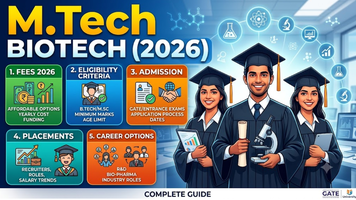
M.Tech (Biotech): Fees 2026, Eligibility Criteria, Admission, Placements and Career Options
Kirti Chauhan
Jul 15 2026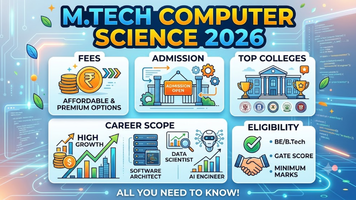
M.Tech (Computer Science Engineering): Fees, Admission, Top Colleges, Career Scope, Eligibility 2026
Kirti Chauhan
Jul 15 2026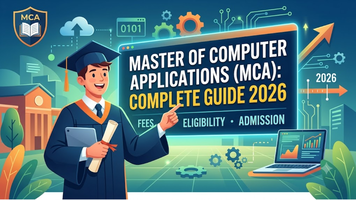
MCA (Master of Computer Application): Fees, Eligibility, Admission 2026 – Complete Guide
Kirti Chauhan
Jul 16 2026
M.Des (Communication Design): Course Details, Fees 2026, Eligibility, Admission, Salary and Career
Kirti Chauhan
Jul 14 2026
Learn More, Grow Faster
Get Updates Straight to Your Inbox!