
Ph.D. in AI: Fees, Eligibility, Admission, Placements and Future Scope 2026
A Ph.D. in AI is a research-based course for students interested in Artificial Intelligence and advanced technology. This article covers Ph.D. in AI fees, eligibility, admission process, placements and career opportunities in 2026. It also explains the future scope, popular research areas and skills needed for a successful AI career.Artificial Intelligence (AI) is among the most rapidly expanding fields in the technology industry, creating new opportunities across various sectors. AI is being used in healthcare, banking, education, automobiles, cybersecurity, robotics and many other industries. Students who want to work on advanced AI research can consider pursuing a Ph.D. in Artificial Intelligence.
A Ph.D. in AI focuses on research in areas such as Machine Learning, Deep Learning, Natural Language Processing, Computer Vision, Robotics and Generative AI. The programme is ideal for students who want to pursue careers in AI research, teaching, or advanced AI technologies.
Here is everything students need to know about Ph.D. in AI in 2026, including eligibility, fees, admission process, career options and future scope.
What is a Ph.D. in Artificial Intelligence?
A Ph.D. in Artificial Intelligence is a doctoral-level research programme. During the programme, students select an AI-related research topic and work on it in depth under the guidance of a research supervisor.
The main aim of the programme is to help students develop new ideas, technologies or solutions in the field of AI. Students may work on areas such as machine learning algorithms, AI models, robotics, computer vision, natural language processing and responsible AI.
The duration of a Ph.D. is generally around 3 to 5 years or more, depending on the university, research topic and progress of the student. For example, IIT Bombay's C-MInDS lists the Ph.D. duration as around 4-5 years.
Ph.D. in AI Highlights 2026
| Particular | Details |
| Course Name | Ph.D. in Artificial Intelligence |
| Level | Doctoral |
| Course Duration | Around 3-5 years or more |
| Main Areas | AI, Machine Learning, Deep Learning, NLP, Robotics, Computer Vision |
| Eligibility | Master's degree or other qualifying degree, depending on university |
| Admission | Entrance test/NET/GATE + Interview, depending on institute |
| Average Fees | Varies by university |
| Career Areas | Research, Academia, Technology, R&D |
| Top Employers | Technology companies, research labs, universities and startups |
Ph.D. in AI Eligibility Criteria 2026
The eligibility criteria can be different from one university to another. Generally, candidates need a relevant master's degree such as M.Tech, M.E., M.Sc., MCA or an equivalent qualification.
Some institutes also allow students with a relevant bachelor's degree to apply for direct Ph.D. programmes.
For example, IIT Hyderabad's Department of Artificial Intelligence allows candidates with relevant M.Tech/ME/MS degrees to apply for its regular Ph.D. programme. It also has specific routes for candidates with bachelor's degrees in CS, AI, Data Science and related fields.
Common eligibility requirements include:
- A relevant postgraduate degree from a recognised university.
- A good academic record.
- Knowledge of mathematics, programming and computer science may be required.
- Some institutes may require GATE, UGC NET or another national-level examination.
- Candidates may have to clear a university-level written test and interview.
Students should check the eligibility rules of the university before applying because requirements can vary.
Ph.D. in AI Admission Process 2026
Admission to a Ph.D. in AI usually takes place through multiple stages.
Step 1: Check eligibility
Candidates should first check whether they meet the academic and examination requirements of the university.
Step 2: Apply online
Eligible candidates need to fill out the Ph.D. application form on the official university website.
Step 3: Entrance examination
Depending on the institute, candidates may be selected through UGC NET/JRF, GATE or a university-level entrance test. UGC regulations allow higher education institutions to use national-level qualifications or their own entrance tests for Ph.D. admissions.
Step 4: Research proposal
Some universities may ask candidates to submit a research proposal. The proposal explains the AI problem the student wants to study.
Step 5: Interview
Shortlisted candidates are generally called for an interview. The interview may focus on the candidate's academic background, research interests and knowledge of the subject.
For instance, IIT Hyderabad states that shortlisted candidates may have to appear for a written test and/or interview.
Step 6: Final selection
After considering academic performance, entrance test results, research proposal and interview performance, the university releases the final selection list.
Ph.D. in AI Fees 2026
The Ph.D. in AI fees depend on the university and type of institution. Government institutes and IITs may have different fee structures from private universities.
Apart from tuition fees, students may also need to pay for:
- Registration
- Examination
- Hostel
- Library
- Laboratory
- Research activities
- Other university charges
The total cost can therefore vary significantly. Students should check the latest fee structure of the university before applying.
Ph.D. in AI Scholarships and Fellowships
Students pursuing a Ph.D. can apply for fellowships and research funding, subject to eligibility.
One important option is the IndiaAI Fellowship. For eligible newly enrolled AI-related Ph.D. students, the programme lists a fellowship of Rs 70,000 per month for the first two years, Rs 75,000 in the third year and Rs 80,000 in the fourth and fifth years, along with a research grant of Rs 2 lakh per year.
Other funding options may include:
- UGC fellowships
- CSIR fellowships
- Institute-funded scholarships
- GATE-related funding at eligible institutes
- Research project funding
- Industry-sponsored research
The availability and amount of financial support can change, so students should check the latest official notification.
Subjects and Research Areas in Ph.D. in AI
The exact subjects depend on the university and research area. Common areas include:
Machine Learning
Students study how machines can learn from data and make predictions or decisions.
Deep Learning
This area focuses on neural networks and their applications in areas such as images, speech and text.
Natural Language Processing
NLP helps computers understand and process human language. Chatbots, translation tools and voice assistants are common applications.
Computer Vision
Computer vision enables computers to understand images and videos. It is used in healthcare, security, automobiles and robotics.
Robotics
Students study how AI can help robots understand their environment and perform tasks.
Generative AI
This is a growing research area involving AI models that can generate text, images, audio, video and other content.
AI Ethics
Research can also focus on issues such as privacy, bias, fairness, transparency and responsible use of AI.
Skills Required for a Ph.D. in AI
Students planning to pursue a Ph.D. in AI should develop strong technical and research skills.
Important skills include:
- Programming
- Python
- Mathematics
- Statistics
- Machine Learning
- Data Analysis
- Research Methodology
- Problem-solving
- Academic Writing
- Communication Skills
Students should also be comfortable reading research papers and working on long-term research problems.
Ph.D. in AI Placements and Career Opportunities
A Ph.D. in AI can open career opportunities in both academia and industry. Unlike undergraduate or postgraduate courses, a Ph.D. is mainly research-focused. Therefore, career opportunities are often related to research, advanced technology and teaching.
AI Research Scientist
AI research scientists work on developing new AI models, algorithms and technologies.
Machine Learning Researcher
Machine learning researchers develop and test new methods that help machines learn from data.
AI Engineer
Ph.D. holders with strong technical skills can work on advanced AI systems and applications.
Data Scientist
Data scientists use data, statistics and machine learning to solve business and technical problems.
University Professor
A Ph.D. can help candidates build a career in teaching and academic research.
Research and Development Scientist
R&D professionals work on new products, technologies and solutions for companies and research organisations.
AI Consultant
AI consultants help organisations understand how AI can be used to improve their products and processes.
Ph.D. in AI Salary
The salary after a Ph.D. in AI depends on the job role, skills, experience, organisation and location. Research scientists and specialised AI professionals with strong technical skills can find opportunities in technology companies, research labs and startups.
Candidates moving into academia can work as professors, assistant professors or researchers, depending on their qualifications and institutional requirements.
It is important to remember that a Ph.D. does not guarantee a fixed salary or placement package. Skills, research publications, experience and the quality of the research profile can have a major impact on career opportunities.
Future Scope of Ph.D. in AI
The future scope of AI research is strong as companies and institutions continue to use AI in different areas.
AI research is expected to grow in areas such as:
- Generative AI
- Machine Learning
- Robotics
- Autonomous vehicles
- Healthcare AI
- Cybersecurity
- Natural Language Processing
- Computer Vision
- AI-powered education
- Financial technology
- Responsible and ethical AI
A Ph.D. can be particularly useful for students who want to work on new AI technologies instead of only using existing tools.
Is Ph.D. in AI a Good Career Option?
Yes, a Ph.D. in AI can be a good option for students who enjoy research, technology and solving complex problems.
However, students should understand that a Ph.D. requires several years of study and research. It is different from a regular degree because the main focus is on creating new knowledge.
Students who want to become researchers, professors, R&D professionals or advanced AI specialists can consider this programme.
Conclusion
A Ph.D. in Artificial Intelligence is a research-focused programme for students interested in advanced AI technologies. The course covers areas such as machine learning, deep learning, robotics, NLP and computer vision.
Eligibility, fees and admission rules vary between universities. Some institutes accept candidates through GATE, UGC NET or institute-level entrance tests, while others have their own selection process.
With the growing use of AI across industries, Ph.D. graduates can explore careers in research, academia, technology companies, AI startups and R&D organisations. Students interested in this field should build strong programming, mathematics, research and problem-solving skills before applying.
FAQs
1. What is a Ph.D. in AI?
A Ph.D. in AI is a research-based doctoral programme focused on Artificial Intelligence. Students work on advanced areas such as Machine Learning, Deep Learning, Robotics, NLP and Computer Vision.
2. What is the eligibility for a Ph.D. in AI?
Generally, candidates need a relevant master's degree such as M.Tech, M.E., M.Sc. or MCA. Eligibility rules may differ from one university to another.
3. How long does a Ph.D. in AI take?
A Ph.D. in AI usually takes around 3 to 5 years or more, depending on the university, research topic and progress of the student.
4. What is the fee for a Ph.D. in AI?
The fees vary depending on the university and institute. Government institutions and private universities may have different fee structures.
5. What is the admission process for a Ph.D. in AI?
Admission may include an entrance exam, academic evaluation, research proposal and personal interview. Some institutes also accept scores from exams such as UGC NET or GATE.
6. What are the popular research areas in AI?
Popular research areas include Machine Learning, Deep Learning, Generative AI, Natural Language Processing, Computer Vision, Robotics and AI Ethics.
7. What jobs can I get after a Ph.D. in AI?
Graduates can work as AI Research Scientists, Machine Learning Researchers, AI Engineers, Data Scientists, R&D Scientists and University Professors.
8. What is the salary after a Ph.D. in AI?
The salary depends on the job role, skills, experience and organisation. Candidates with strong research and technical skills can find opportunities in technology companies, research labs and universities.
9. Is a Ph.D. in AI a good career option?
Yes, it can be a good option for students who enjoy research, technology and solving complex problems. It is especially useful for careers in AI research, academia and advanced technology.
10. What is the future scope of a Ph.D. in AI?
The future scope is strong due to the growing use of AI in healthcare, banking, automobiles, robotics, cybersecurity, education and other industries.
Latest Articles

Ph.D. Program in Computer Science Engineering: Fees, Eligibility Criteria, Admission, Placements and Future Scope 2026
Kirti Chauhan
Aug 12 2026
NEET PG 2026 City Allocation Mistake: Students Express Discontent Over Arbitrary City Assignments; NBE Provides Clarification
UniList Desk
Aug 12 2026
Dates for Round 3 of COMEDK UGET 2026 Counseling Have Been Released; View the Full Schedule Here
UniList Desk
Aug 12 2026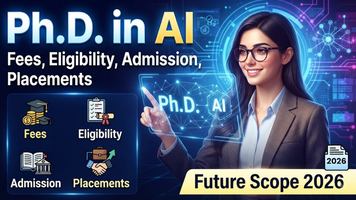
Ph.D. in AI: Fees, Eligibility, Admission, Placements and Future Scope 2026
Kirti Chauhan
Aug 12 2026
Final Day for Registration in Maharashtra NEET UG Counselling 2026: Steps to Apply
UniList Desk
Aug 12 2026
NEET UG Counseling 2026: MCC Publishes Supplementary CW List for Delhi Quota MBBS and BDS Admissions
UniList Desk
Aug 12 2026
Counselling for IPU BTech 2026 Spot Round 2 Delayed; Find Information Here
UniList Desk
Aug 12 2026
Registration for AP NEET UG Counseling 2026 Without Late Fee Ends Today; Submit Applications Before the Cutoff
UniList Desk
Aug 12 2026
Registration for Telangana NEET UG Counseling Concludes Today; Review Application Steps
UniList Desk
Aug 12 2026
Deadline for Registration in Gujarat NEET UG Counselling 2026 is Today: Submit Applications at medadmgujarat.org
UniList Desk
Aug 12 2026
Learn More, Grow Faster
Get Updates Straight to Your Inbox!