
B.Tech vs BCA vs B.Sc: Which Should You Pick After Class 12 Science?
Choosing the right course after Class 12 Science can be challenging with options like B.Tech, BCA and B.Sc. This article compares B.Tech vs BCA vs B.Sc based on eligibility, duration, curriculum, career scope and future opportunities. It explains which course may suit students based on their interests and career goals. Students can use this comparison to understand the differences before selecting an undergraduate programme.Deciding what to study after 12th Science isn't easy when B.Tech, BCA, and B.Sc are all on the table. Here's a breakdown of how these three degrees differ — in terms of eligibility, structure, subjects covered, and where they can lead — so you can weigh your options with more clarity.
B.Tech vs BCA vs B.Sc: Quick Comparison
| Aspect | B.Tech | BCA | B.Sc |
| Stands For | Bachelor of Technology | Bachelor of Computer Applications | Bachelor of Science |
| Duration | 4 years | 3 years | 3 years |
| Core Emphasis | Engineering & technology | Software & computer applications | Science and focused subject areas |
| Common Tracks | CSE, AI, Data Science, ECE, Mechanical | Computer Applications, Data Science, AI | Physics, Chemistry, Math, CS, Biotech |
| Typical Fields | Software, engineering, tech, R&D | Software, IT, web/app development | Research, analytics, teaching, sci-tech roles |
| Further Study | M.Tech, MBA, MS | MCA, MBA, MSc | MSc, MBA, specialized master's programs |
B.Tech: Who Is It For?
B.Tech is a four-year engineering degree, well suited to students aiming for careers in engineering, software, or cutting-edge technology fields.
Common specializations include:
- Computer Science and Engineering
- Artificial Intelligence
- Data Science
- Information Technology
- Electronics and Communication
- Mechanical Engineering
- Biotechnology
- Electrical Engineering
If your interests lean toward software engineering, AI, data science, cybersecurity, or core engineering work, B.Tech is worth considering.
BCA: Who Is It For?
BCA is a degree centered on computing, programming, and software concepts — a good route into IT and software careers without going the engineering-degree path.
Typical coursework touches on:
- Programming
- Database management
- Web development
- Computer networks
- Software development
- Data structures
- Operating systems
BCA graduates often move into roles like software developer, web developer, system admin, technical support, or database work, and many go on to pursue an MCA afterward.
B.Sc: Who Is It For?
B.Sc lets students dig deeper into a specific science or tech-adjacent subject, with the actual curriculum shaped heavily by which specialization you pick.
Popular options include:
- B.Sc Physics
- B.Sc Chemistry
- B.Sc Mathematics
- B.Sc Computer Science
- B.Sc Biotechnology
- B.Sc Statistics
- B.Sc Data Science
It tends to suit students drawn to research, academics, lab-based work, data, or other specialized scientific areas.
So Which One's Actually Better?
Honestly, there isn't a universal "best" — it comes down to what you enjoy, your Class 12 subject strengths, your career direction, and whether you plan to study further.
- Want deep technical/engineering training? → B.Tech
- Mainly interested in programming and software? → BCA
- Want to specialize in a science subject, possibly heading toward research? → B.Sc
Career Scope Compared
After B.Tech, you could head into:
Software development, engineering roles, AI, data science, cybersecurity, electronics, product development, or R&D.
After BCA, common paths include:
Software development, web/app development, IT support, database management, system admin, or QA/testing.
After B.Sc, outcomes vary a lot by specialization, but can include:
Research, data analytics, lab work, teaching, healthcare/biotech, IT and software, or other scientific services — often paired with a postgraduate degree for specialization.
What About Salary?
Pay isn't really determined by the degree name alone — it depends on your specialization, skills (programming, cloud, AI, data, cybersecurity, etc.), experience, location, employer, and any further qualifications. A B.Tech, BCA, or B.Sc (CS) graduate can all land solid tech careers if they build the right skill set; B.Sc grads in core sciences often find their earning path through research, academia, or specialized postgrad routes.
B.Tech vs BCA vs B.Sc: Eligibility
B.Tech
- Class 12 (or equivalent) from a recognized board
- Physics and Math typically required
- A third subject (Chemistry, Computer Science, etc.) may be needed depending on the program
- Admission via entrance exam, merit, or both
BCA
- Class 12 (or equivalent)
- Some universities want Math or Computer Science
- Requirements differ by institution
B.Sc
- Class 12 (or equivalent)
- Subject requirements depend on your chosen specialization
- Some programs need Math, Biology, Physics, or Chemistry
Always double-check the specific university's requirements before applying.
For Computer Science Specifically
If computing is your focus, each route offers a different flavor:
- B.Tech CSE — engineering-heavy, covering programming, algorithms, networks, OS, and software engineering
- BCA — more applications- and programming-focused
- B.Sc CS — a science-oriented approach to computing, often followed by an MSc or similar postgrad study
It really comes down to whether you'd rather approach computing as an engineer, an applications specialist, or a scientist.
Match Your Interest to a Course
| If you're into... | Consider... |
| Engineering & technology | B.Tech |
| Software development | B.Tech CSE / BCA / B.Sc CS |
| Artificial Intelligence | B.Tech AI / BCA / B.Sc AI tracks |
| Data Science | B.Tech, B.Sc, or BCA with a data specialization |
| Pure science | B.Sc |
| Research & academia | B.Sc + further studies |
| Computer applications | BCA |
| Broad engineering options | B.Tech |
Bottom Line
B.Tech, BCA, and B.Sc are all solid choices after 12th Science, but they cater to different interests. Go B.Tech for engineering and advanced tech, BCA for a computer-applications focus, or B.Sc if core science or research appeals to you. Whatever you pick, it's worth comparing curriculum, fees, specializations, career outcomes, and placement records across specific colleges before deciding.
FAQ
Q. Which is better after 12th Science — B.Tech, BCA, or B.Sc?
It depends on your goals: B.Tech = engineering/tech, BCA = computer applications, B.Sc = specialized science.
Q. Is BCA better than B.Tech for tech jobs?
Both can lead to solid tech careers — B.Tech is engineering-based, BCA is applications/software-focused.
Q. Can Science stream students take BCA?
Yes, as long as you meet the university's eligibility criteria.
Q. Can Science stream students take B.Sc?
Yes — it's a very common choice, with subject requirements varying by specialization.
Q. Which degree has the most scope?
All three open different doors — scope really hinges on specialization, skills, experience, and further education.
Q. Can I do MCA after BCA?
Yes, provided you meet the program's eligibility criteria.
Q. Can I study further after B.Tech?
Yes — M.Tech, MS, MBA, and similar options are all available.
Latest Articles

CPGET 2026 Phase 2 Counselling Registration Commences
UniList Desk
Sep 22 2026
MCC Opens NEET UG 2026 Round 3 Counselling Registration
UniList Desk
Sep 22 2026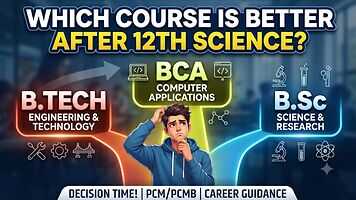
B.Tech vs BCA vs B.Sc: Which Should You Pick After Class 12 Science?
Kirti Chauhan
Sep 22 2026
Karnataka PGCET 2026 Round 1 Seat Allotment Results Releasing Today
UniList Desk
Sep 22 2026
IIT JAM 2027: Application Deadline Extended to October 19
UniList Desk
Sep 22 2026
AIMA Expected to Release MAT September 2026 Results in Early October
UniList Desk
Sep 22 2026
Rashtriya Indian Military College Entrance Exam 2026: Application Process Begins
UniList Desk
Sep 22 2026
SSC CGL 2026 Tier 1 Exam City Intimation Slip Released at ssc.gov.in
UniList Desk
Sep 22 2026
Proposed Changes for MHT CET 2027: Potential Shift in Exam Timeline and Merit Criteria
UniList Desk
Sep 22 2026
ABVMU Opens Registration for UP CNET 2026 Special Stray Round Counselling
UniList Desk
Sep 22 2026
Learn More, Grow Faster
Get Updates Straight to Your Inbox!