
MBA Healthcare Management vs MBA Business Analytics: Which is Better in 2026?
MBA Healthcare Management and MBA Business Analytics are two specialised management programmes offering different career paths in 2026. While Healthcare Management focuses on hospitals, healthcare operations and administration, Business Analytics deals with data-driven business decisions. This article compares both MBA specialisations based on eligibility, subjects, skills, career options, salary and future scope. It also explains which MBA may be more suitable based on a student's interests, skills and long-term career goals.Choosing the right MBA specialisation can influence the type of roles, industries and career opportunities a student can explore after graduation. Two specialisations that are gaining attention in 2026 are MBA Healthcare Management and MBA Business Analytics. While both are management programmes, they prepare students for very different career paths.
An MBA in Healthcare Management focuses on managing hospitals, healthcare organisations, medical services, pharmaceutical businesses and other healthcare operations. On the other hand, an MBA in Business Analytics combines management education with data analysis, helping students use data to support business decisions.
So, MBA Healthcare Management vs MBA Business Analytics: which is better in 2026? The answer depends on a student's interests, skills and career goals. This article compares both programmes based on subjects, eligibility, skills, career options, salaries, industries and future scope.
MBA Healthcare Management vs MBA Business Analytics: Quick Comparison
| Particulars | MBA Healthcare Management | MBA Business Analytics |
| Course focus | Healthcare and management | Business, data and analytics |
| Duration | Usually 2 years | Usually 2 years |
| Main area | Healthcare operations and administration | Data-driven business decision-making |
| Suitable for | Students interested in healthcare management | Students interested in data and business |
| Important skills | Leadership, communication, healthcare operations | Analytical thinking, statistics, data interpretation |
| Common roles | Hospital Administrator, Healthcare Manager, Operations Manager | Business Analyst, Data Analyst, Analytics Consultant |
| Major sectors | Hospitals, pharmaceuticals, health-tech, diagnostics | IT, BFSI, consulting, e-commerce, retail, manufacturing |
| Technical requirement | Generally moderate | Generally higher |
| Career flexibility | Mainly healthcare-related sectors | Wider cross-industry opportunities |
What is an MBA in Healthcare Management?
An MBA in Healthcare Management is a postgraduate management programme designed for students who want to build careers in the healthcare sector. The programme combines business management concepts with knowledge of healthcare administration and operations.
Students may learn about areas such as hospital administration, healthcare marketing, healthcare finance, healthcare operations, human resource management, healthcare policies and quality management.
The course can be suitable for students who want managerial positions rather than clinical roles. Students do not necessarily need to become doctors or healthcare professionals to pursue healthcare management. However, eligibility requirements vary between institutes and programmes.
MBA Healthcare Management Subjects
The curriculum can differ across universities, but students may study subjects such as:
- Healthcare Operations Management
- Hospital Administration
- Healthcare Marketing
- Healthcare Finance
- Healthcare Human Resource Management
- Healthcare Quality Management
- Healthcare Information Systems
- Healthcare Laws and Ethics
- Strategic Management
- Financial Management
- Marketing Management
- Human Resource Management
What is an MBA in Business Analytics?
An MBA in Business Analytics combines traditional business management education with analytical and data-related skills. The programme teaches students how to examine business data and use insights to solve organisational problems.
Students may learn statistical methods, data visualisation, predictive analysis, business intelligence and analytical decision-making. Depending on the institute, the programme may also include tools and technologies used for data analysis.
This specialisation can be useful for students who enjoy working with numbers, data, technology and business strategy.
MBA Business Analytics Subjects
The syllabus varies by university, but common areas may include:
- Business Analytics
- Statistics for Business
- Data Visualisation
- Predictive Analytics
- Business Intelligence
- Financial Analytics
- Marketing Analytics
- Operations Analytics
- Data Mining
- Strategic Management
- Database Management
- Artificial Intelligence and Machine Learning fundamentals
MBA Healthcare Management vs MBA Business Analytics: Eligibility
The basic eligibility criteria for both programmes are generally similar. Candidates usually need a bachelor's degree from a recognised university. Some institutes may require a minimum percentage or CGPA.
Admission can be based on entrance examinations, academic performance, interviews, group discussions or a combination of these, depending on the university.
Students should check the eligibility and admission requirements of the specific college before applying.
MBA Healthcare Management vs MBA Business Analytics: Skills Required
The two specialisations require different skill sets.
Skills for MBA Healthcare Management
Students interested in healthcare management can benefit from:
- Leadership skills
- Communication skills
- Problem-solving ability
- Team management
- Decision-making
- Organisational skills
- Understanding of healthcare operations
- Knowledge of business management
The ability to communicate effectively is particularly important because healthcare managers often coordinate with doctors, nurses, administrative teams, patients, suppliers and other stakeholders.
Skills for MBA Business Analytics
Business Analytics students generally need:
- Analytical thinking
- Numerical ability
- Statistical understanding
- Problem-solving skills
- Data interpretation
- Logical reasoning
- Business understanding
- Data visualisation skills
- Basic knowledge of analytical tools
Students who are comfortable working with spreadsheets, databases, statistics and analytical software may find this specialisation more suitable.
MBA Healthcare Management vs MBA Business Analytics: Career Options
One of the biggest differences between the two programmes is the range of industries in which graduates can work.
Career Options After MBA Healthcare Management
Graduates can explore roles such as:
- Healthcare Manager
- Hospital Administrator
- Healthcare Operations Manager
- Hospital Operations Executive
- Healthcare Consultant
- Healthcare Marketing Manager
- Healthcare Quality Manager
- Medical Practice Manager
- Health Services Manager
- Pharmaceutical Management Professional
Potential employers can include hospitals, diagnostic centres, pharmaceutical companies, health-tech companies, insurance organisations, medical equipment companies and healthcare consulting firms.
Career Options After MBA Business Analytics
Business Analytics graduates can explore roles such as:
- Business Analyst
- Data Analyst
- Business Intelligence Analyst
- Analytics Consultant
- Marketing Analyst
- Financial Analyst
- Operations Analyst
- Risk Analyst
- Product Analyst
- Data-driven Strategy Professional
The cross-industry nature of analytics means graduates can find opportunities in sectors such as IT, banking, financial services, consulting, e-commerce, retail, telecommunications, manufacturing and logistics.
MBA Healthcare Management vs MBA Business Analytics: Salary
Salary after an MBA depends on several factors, including the college, job role, location, work experience, industry and individual skills. Therefore, there is no single salary figure that applies to every graduate.
Business Analytics graduates may have access to higher-paying roles in some technology, consulting and financial services companies, particularly when they have strong analytical and technical skills.
Healthcare Management graduates can also build well-paying careers, especially after gaining experience in hospital administration, healthcare operations, consulting, pharmaceutical management or health-tech.
Students should compare role-specific salary data rather than choosing a course only on the basis of an expected average salary.
MBA Healthcare Management vs MBA Business Analytics: Future Scope
Both specialisations have scope, but their growth areas are different.
Future Scope of MBA Healthcare Management
The healthcare industry requires professionals who can manage operations, finances, people, technology and service delivery. The expansion of hospitals, diagnostics, health-tech platforms, pharmaceutical businesses and other healthcare services can create opportunities for management professionals.
The increasing use of digital healthcare, telemedicine, healthcare technology and data-based healthcare services is also changing the responsibilities of healthcare managers.
Future Scope of MBA Business Analytics
Businesses across sectors generate large amounts of data. Companies need professionals who can convert this data into useful insights for planning and decision-making.
Business Analytics graduates can therefore explore opportunities in areas such as:
- Artificial intelligence
- Business intelligence
- Data-driven marketing
- Financial analytics
- Supply chain analytics
- Product analytics
- Customer analytics
- Risk analytics
- Predictive analytics
The growing use of automation and AI is also making analytical and data-literacy skills increasingly relevant to management professionals.
MBA Healthcare Management vs MBA Business Analytics: Which is Easier?
Neither specialisation can be considered universally easier because the difficulty depends on a student's background and interests.
Students who enjoy communication, administration, people management and healthcare-related subjects may find MBA Healthcare Management more comfortable.
Students who enjoy mathematics, statistics, technology, data and problem-solving may find MBA Business Analytics more suitable.
Business Analytics can involve more quantitative and technical coursework, while Healthcare Management can require a stronger understanding of healthcare systems and organisational operations.
MBA Healthcare Management vs MBA Business Analytics: Which is Better for Jobs?
If the main priority is industry flexibility, MBA Business Analytics may have an advantage because analytical roles are available across multiple sectors.
For students who are specifically interested in hospitals, healthcare companies, pharmaceuticals or health-tech, MBA Healthcare Management can be the more relevant choice.
Therefore:
- Choose MBA Healthcare Management if you want to build a career in healthcare administration and management.
- Choose MBA Business Analytics if you want to work with data and business decision-making.
- Choose MBA Business Analytics if you want to keep your career options open across multiple industries.
- Choose MBA Healthcare Management if you have a clear interest in the healthcare sector.
MBA Healthcare Management vs MBA Business Analytics: Which is Better in 2026?
There is no single answer to which MBA is better in 2026. Both programmes offer different career pathways.
MBA Business Analytics may be a better option for students looking for broader industry opportunities and who are comfortable with data, statistics and technology. It can lead to roles across IT, consulting, finance, retail, e-commerce and other sectors.
MBA Healthcare Management may be a better option for students who specifically want to work in healthcare and management. It can provide relevant knowledge for careers in hospitals, pharmaceuticals, diagnostics, health-tech and healthcare services.
Ultimately, students should select a specialisation based on their interests, existing skills, preferred industry and long-term career goals, rather than choosing a programme only because it is considered popular.
MBA Healthcare Management vs MBA Business Analytics: Which One Should You Choose?
The following points can help students make a decision:
| If you are interested in... | Recommended specialisation |
| Hospitals and healthcare organisations | MBA Healthcare Management |
| Healthcare administration | MBA Healthcare Management |
| Pharmaceutical management | MBA Healthcare Management |
| Health-tech | MBA Healthcare Management |
| Data analysis | MBA Business Analytics |
| Business intelligence | MBA Business Analytics |
| Data-driven decision-making | MBA Business Analytics |
| Analytics and consulting | MBA Business Analytics |
| Working across different industries | MBA Business Analytics |
| Healthcare operations | MBA Healthcare Management |
Conclusion
The choice between MBA Healthcare Management and MBA Business Analytics depends largely on the career direction a student wants to follow.
MBA Healthcare Management is focused on the business and administrative side of the healthcare industry, while MBA Business Analytics focuses on using data to improve business decisions. Both can lead to promising management careers, but they require different interests and skills.
For students who want healthcare-specific careers, MBA Healthcare Management can be a suitable choice. For those who want data-focused roles and wider industry exposure, MBA Business Analytics can be a strong option.
Before selecting a programme, students should compare the curriculum, college reputation, fees, placement record, internship opportunities, faculty, industry exposure and career outcomes of individual institutions.
FAQs
1. Which is better, MBA Healthcare Management or MBA Business Analytics?
Neither programme is universally better. MBA Healthcare Management is more suitable for students interested in healthcare, while MBA Business Analytics is better suited to students interested in data, analytics and technology-driven business roles.
2. Is MBA Business Analytics in demand in 2026?
Business Analytics continues to be relevant as companies increasingly use data for business planning, customer analysis, operations and decision-making. Career opportunities depend on the candidate's skills, college, experience and job market.
3. Is MBA Healthcare Management a good career option?
Yes, it can be a suitable career option for students interested in healthcare administration, hospital management, pharmaceuticals, diagnostics and health-tech.
4. Which MBA has more career options?
MBA Business Analytics generally provides access to a wider range of industries because analytics functions are used in sectors such as IT, finance, consulting, retail, manufacturing and e-commerce. Healthcare Management is more specialised towards the healthcare sector.
5. Can a student without a healthcare background pursue MBA Healthcare Management?
In many institutions, students from different undergraduate backgrounds can apply for an MBA in Healthcare Management. However, eligibility rules differ by college, so candidates should check the admission requirements of their preferred institution.
Latest Articles

Uttarakhand NEET UG 2026: Round 3 Seat Matrix and Allotment Schedule Released
UniList Desk
Oct 06 2026
GATE 2027 Registration: How to Check Your Application Status and Scrutiny Updates
UniList Desk
Oct 06 2026
CEE Kerala Extends Deadline for KLEE LLM Round 1 Option Registration
UniList Desk
Oct 06 2026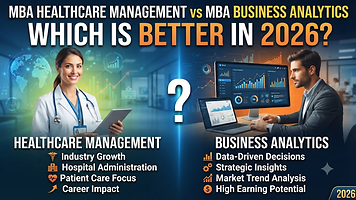
MBA Healthcare Management vs MBA Business Analytics: Which is Better in 2026?
Kirti Chauhan
Oct 06 2026
JEE Main 2027: Analyzing Registration Timelines Following January Exam Date Announcement
UniList Desk
Oct 06 2026
CISCE Expected to Release ICSE Class 10 Date Sheet 2027 Soon
UniList Desk
Oct 06 2026
Karnataka NEET PG 2026 Round 1 Counselling Registration Opens
UniList Desk
Oct 06 2026
SBI PO Mains Result 2026: Expected Timeline and Selection Process Details
UniList Desk
Oct 06 2026
Manipal Entrance Test 2027 Registration Expected to Begin in October
UniList Desk
Oct 06 2026
Haryana Open School 10th October 2026 Exams: Schedule and Guidelines
UniList Desk
Oct 06 2026
Learn More, Grow Faster
Get Updates Straight to Your Inbox!