
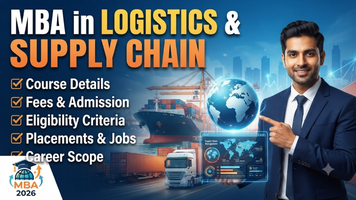
MBA in Logistics & Supply Chain: Course Details, Fees, Eligibility, Admission, Placements & Career Scope 2026
An MBA in Logistics & Supply Chain equips students with expertise in logistics, procurement, inventory management, transportation, and supply chain strategy. With strong placement opportunities across industries like e-commerce, manufacturing, retail, and global trade, this specialization offers excellent salary potential and long-term career growth.An MBA in Logistics & Supply Chain Management is a two-year postgraduate degree designed to equip students with the skills needed to oversee procurement, inventory management, warehousing, transportation, and the efficient movement of goods across domestic and global supply chains. With the rapid growth of e-commerce, manufacturing, retail, and international trade, companies are increasingly looking for professionals who can optimize supply chain processes and reduce operational costs.
This specialization combines business management with logistics planning, procurement strategies, inventory control, and digital supply chain technologies. Graduates can build rewarding careers in industries such as retail, manufacturing, FMCG, pharmaceuticals, logistics, aviation, shipping, and e-commerce.
What is MBA in Logistics & Supply Chain?
MBA in Logistics & Supply Chain Management is a management program focused on planning, implementing, and managing the flow of products and services from manufacturers to consumers.
The curriculum includes logistics planning, procurement management, transportation, warehouse operations, inventory management, global supply chain strategies, business analytics, and digital transformation.
Students also develop managerial, analytical, communication, and leadership skills required to oversee complex supply chain operations.
MBA in Logistics & Supply Chain Highlights
| Particulars | Details |
| Course Name | MBA in Logistics & Supply Chain Management |
| Course Level | Postgraduate |
| Duration | 2 Years |
| Course Type | Full-Time, Part-Time, Online, Executive |
| Eligibility | Bachelor's degree with minimum 50% marks |
| Admission | Entrance Exam + GD/PI or Merit-Based |
| Average Fees | Rs 2 lakh – Rs 20 lakh |
| Average Salary | Rs 6 LPA – Rs 12 LPA |
| Top Recruiters | Amazon, Flipkart, DHL, Maersk, Blue Dart, Delhivery, TCS, Reliance, Adani Logistics |
MBA in Logistics & Supply Chain Eligibility
Candidates seeking admission must satisfy the eligibility criteria prescribed by the respective institute.
The general eligibility requirements include:
- Bachelor's degree from a recognized university
- Minimum 50% aggregate marks (45% for reserved categories in some institutes)
- Final-year students may also apply
- Valid entrance exam score (for most institutes)
Some universities may also conduct personal interviews and group discussions during admissions.
MBA in Logistics & Supply Chain Admission Process
The admission process generally consists of the following steps:
Step 1: Check Eligibility
Candidates must have completed graduation from a recognized university.
Step 2: Appear for Entrance Exams
Most business schools accept scores from national or university-level entrance exams.
Popular MBA entrance exams include:
- CAT
- XAT
- MAT
- CMAT
- NMAT
- SNAP
- ATMA
- CUET PG
- State MBA entrance exams
Step 3: Application Process
Apply online through the official website of the preferred college.
Step 4: GD/PI Round
Shortlisted candidates are invited for Group Discussion (GD), Personal Interview (PI), or Written Ability Test (WAT).
Step 5: Final Admission
Admission is offered based on:
- Entrance exam score
- Academic performance
- GD/PI performance
- Work experience (if applicable)
MBA in Logistics & Supply Chain Fees
The course fees vary depending on the institution.
| Institute Type | Average Fees |
| Government Colleges | Rs 50,000 – Rs 4 lakh |
| Private Colleges | Rs 4 lakh – Rs 20 lakh |
| Executive MBA | Rs 5 lakh – Rs 18 lakh |
| Online MBA | Rs 1 lakh – Rs 3 lakh |
MBA in Logistics & Supply Chain Syllabus
The syllabus combines management principles with logistics and supply chain operations.
First Year Subjects
- Principles of Management
- Financial Accounting
- Marketing Management
- Business Economics
- Human Resource Management
- Operations Management
- Business Statistics
- Organizational Behaviour
Second Year Subjects
- Supply Chain Management
- Logistics Management
- Procurement Management
- Inventory Management
- Warehouse Management
- Transportation Management
- International Logistics
- Retail Supply Chain
- Demand Forecasting
- ERP & SAP
- Supply Chain Analytics
- Project Management
- Business Analytics
- Capstone Project
Skills Required for MBA in Logistics & Supply Chain
Students should develop the following skills:
- Problem-solving
- Analytical thinking
- Leadership
- Communication skills
- Negotiation skills
- Data analysis
- Inventory planning
- Time management
- Decision-making
- Strategic planning
- Digital supply chain knowledge
Top MBA Logistics & Supply Chain Colleges in India
Some leading institutes offering this specialization include:
- Indian Institute of Management (IIMs)
- Indian Institute of Foreign Trade (IIFT)
- Symbiosis Institute of Business Management
- Great Lakes Institute of Management
- Narsee Monjee Institute of Management Studies (NMIMS)
- Amity University
- Lovely Professional University
- UPES Dehradun
- Bennett University
- MIT-WPU
MBA in Logistics & Supply Chain Placements
Placement opportunities are excellent because supply chain management is one of the fastest-growing business functions.
Graduates are recruited by:
- E-commerce companies
- Manufacturing firms
- Retail chains
- Automobile companies
- Pharmaceutical companies
- Shipping companies
- Logistics providers
- FMCG companies
- Consulting firms
Top Recruiters
- Amazon
- Flipkart
- DHL
- Blue Dart
- Delhivery
- FedEx
- Maersk
- Reliance Retail
- Adani Logistics
- Tata Projects
- Infosys
- TCS
- Accenture
- EY
- Deloitte
MBA in Logistics & Supply Chain Salary in India
Salary depends on experience, college, location, and company.
| Experience | Average Salary |
| Freshers | Rs 6 LPA – Rs 9 LPA |
| 3–5 Years | Rs 10 LPA – Rs 18 LPA |
| 5–10 Years | Rs 18 LPA – Rs 30 LPA+ |
| Senior Leadership | Rs 35 LPA – Rs 60 LPA+ |
Career Opportunities After MBA in Logistics & Supply Chain
Graduates can work across multiple industries.
Popular job roles include:
- Supply Chain Manager
- Logistics Manager
- Procurement Manager
- Operations Manager
- Warehouse Manager
- Inventory Manager
- Distribution Manager
- Demand Planner
- Purchasing Manager
- Global Supply Chain Analyst
- Transportation Manager
- Import Export Manager
- Operations Consultant
- Vendor Relationship Manager
Future Scope of MBA in Logistics & Supply Chain
The future scope of MBA in Logistics & Supply Chain is highly promising as businesses increasingly rely on efficient logistics networks and digital supply chain solutions. The expansion of e-commerce, quick commerce, manufacturing, exports, and global trade has significantly increased the demand for skilled supply chain professionals.
Emerging technologies such as Artificial Intelligence (AI), Internet of Things (IoT), blockchain, automation, robotics, and predictive analytics are transforming supply chain operations. Companies require managers who can leverage these technologies to improve efficiency and reduce costs.
Professionals can pursue careers in:
- E-commerce
- Manufacturing
- Retail
- Aviation
- Shipping
- Ports
- Pharmaceuticals
- FMCG
- Consulting
- Global Trade
- Government logistics organizations
With experience, graduates can move into leadership roles such as Supply Chain Director, Head of Operations, Procurement Director, Chief Operations Officer (COO), or Vice President – Supply Chain.
Why Choose MBA in Logistics & Supply Chain?
Some key benefits of pursuing this specialization include:
- High demand across industries
- Excellent placement opportunities
- Competitive salary packages
- Global career prospects
- Leadership and managerial roles
- Exposure to international trade
- Opportunities in multinational companies
- Growing demand due to digital transformation
- Strong career progression
- Diverse job opportunities
Frequently Asked Questions (FAQs)
Is MBA in Logistics & Supply Chain a good career?
Yes. It is one of the fastest-growing MBA specializations due to increasing demand in e-commerce, manufacturing, retail, and global trade.
What is the eligibility for MBA in Logistics & Supply Chain?
Candidates must hold a bachelor's degree with at least 50% marks from a recognized university. Most institutes also require a valid MBA entrance exam score.
What is the average salary after MBA in Logistics & Supply Chain?
Fresh graduates typically earn between Rs 6 LPA and Rs 9 LPA, while experienced professionals can earn Rs 20 LPA or more, depending on the company and role.
Which entrance exams are accepted?
Common entrance exams include CAT, XAT, MAT, CMAT, NMAT, SNAP, ATMA, and CUET PG.
Which industries hire MBA Logistics & Supply Chain graduates?
Top hiring sectors include e-commerce, manufacturing, retail, FMCG, pharmaceuticals, logistics, shipping, aviation, consulting, and international trade.
Latest Articles
MBA in Logistics & Supply Chain: Course Details, Fees, Eligibility, Admission, Placements & Career Scope 2026
Kirti Chauhan
Jul 28 2026
Deadline for NEET PG 2026 Correction Window Closes Today; Update Information at @natboard.edu.in
UniList Desk
Jul 28 2026
Candidates Seek Official Update from NTA on Delay of UGC NET 2026 Answer Key
UniList Desk
Jul 28 2026
Seat Matrix for CAP Round 1 of MHT CET 2026 Now Available; Review College-specific Seat Allocations
UniList Desk
Jul 28 2026
Final Merit List for MAH MBA CET 2026 Released; View Seat Matrix Here
UniList Desk
Jul 27 2026
MHT CET CAP 2026: CET Cell Reverses Increase in Seat Acceptance Fee; Candidates Will Still Pay ₹1,000
UniList Desk
Jul 27 2026
Results for Round 2 Seat Allocation of MP BE 2026 Announced
UniList Desk
Jul 27 2026
Mizoram Releases Initial Merit List for NEET 2026 on @dhte.mizoram.gov.in; 385 Students Achieve MBBS and BDS Admissions
UniList Desk
Jul 27 2026
CCMN 2026 Special Round 2 Seat Allocation Results Released; Access Your Allocation Outcome at ccmn.admissions.nic.in
UniList Desk
Jul 27 2026
Choice Filling for JEECUP 2026 Round 4 Begins: Seat Allocation Scheduled for July 30
UniList Desk
Jul 27 2026
Learn More, Grow Faster
Get Updates Straight to Your Inbox!