
PhD in Physics: Fees, Eligibility Criteria, Admission, Placements and Future Scope 2026
A PhD in Physics is a research-based doctoral programme for students interested in advanced physics and scientific research. This article covers PhD in Physics fees, eligibility criteria, admission process, syllabus and entrance exams in 2026. It also explains PhD in Physics placements, salary, career opportunities and future scope in India. Students can also learn about top institutes, research areas and career options after completing a PhD in Physics.A PhD in Physics is a research-based doctoral programme for students who want to study advanced topics in physics and build a career in research, teaching, technology or scientific organisations. The programme allows students to work on a specific research problem under the guidance of a faculty member or research supervisor.
In India, the duration of a PhD is generally at least three years, including coursework. Under the UGC PhD Regulations, the maximum duration is generally six years, subject to the applicable rules of the university or institution.
Students can pursue research in areas such as quantum physics, astrophysics, nuclear physics, particle physics, condensed matter physics, optics, photonics, materials science, nanotechnology and computational physics.
What is a PhD in Physics?
A Doctor of Philosophy (PhD) in Physics is the highest academic degree in the field of physics. It focuses mainly on research rather than classroom-based learning.
During the programme, students complete research work on a selected topic, attend required coursework, conduct experiments or theoretical studies, publish research papers and finally submit a doctoral thesis.
The exact course structure and research areas vary from one university to another.
PhD in Physics Highlights 2026
| Particulars | Details |
| Course Name | PhD in Physics |
| Degree Level | Doctoral |
| Course Duration | Minimum 3 years |
| Eligibility | Master's degree or equivalent in Physics/relevant field; criteria vary by institute |
| Admission | Entrance test/NET/GATE/JEST/fellowship + interview, depending on institute |
| Main Areas | Quantum Physics, Astrophysics, Nuclear Physics, Optics, Condensed Matter and more |
| Average Fees | Varies by university and category |
| Career Areas | Research, teaching, R&D, scientific organisations, technology and data-related fields |
PhD in Physics Eligibility Criteria 2026
The PhD in Physics eligibility criteria are different for each university and IIT. In general, candidates need a relevant postgraduate degree with the required marks or grade.
For example, IIT Dharwad's 2026-27 Physics PhD admission brochure lists M.Sc. or equivalent degrees in Physics and related areas as eligible qualifications. It also accepts certain M.Tech./M.S. backgrounds in areas such as optics, photonics, engineering physics and related fields, subject to the institute's conditions.
Common eligibility requirements include:
- A Master's degree in Physics or a related subject such as Applied Physics.
- Some institutes also accept M.Tech., M.S., Engineering Physics or related engineering degrees.
- Candidates generally need the minimum marks, CGPA or class specified by the university.
- A valid CSIR-UGC NET/JRF, UGC-NET, GATE, JEST or another recognised qualification may be required or preferred for some admission categories.
- Candidates with a four-year bachelor's degree may also be eligible at some institutes, subject to their specific rules.
For example, IIT Indore's 2026 Physics PhD advertisement includes M.Sc./M.S./M.Tech. qualifications in Physics and related areas and also lists a four-year UG degree in Engineering Physics/Applied Physics for eligible routes.
Therefore, students should always check the latest admission notification of the university before applying.
PhD in Physics Admission Process 2026
The PhD in Physics admission process usually involves several stages. The process can differ between IITs, universities and research institutes.
Step 1: Check Eligibility
First, candidates need to check whether they meet the academic and examination requirements of the institute.
Step 2: Qualify for the Required Examination
Depending on the institute and admission category, candidates may need a valid score or qualification in examinations such as:
- CSIR-UGC NET/JRF
- UGC-NET
- GATE
- JEST
- INSPIRE Fellowship
- Institute-level PhD entrance examination
UGC regulations allow higher education institutions to admit candidates with recognised fellowships or national-level qualifications through an interview. Institutions may also conduct their own entrance test followed by an interview.
Step 3: Apply Online
Candidates need to visit the official website of the university or institute and fill out the PhD application form. They generally need to upload academic documents, examination scores, research details and other required information.
Step 4: Shortlisting
The institute shortlists candidates based on academic performance, qualifying examinations, research interests and other criteria.
Step 5: Written Test and Interview
Many institutes conduct a written test and/or research interview.
For example, IIT Madras's 2026 Physics PhD selection process includes shortlisting, a written test and an interview. Final selection is based on the combined performance in the selection stages.
Step 6: Final Admission
Selected candidates complete document verification, pay the required fees and join the PhD programme.
PhD in Physics Fees in India 2026
The PhD in Physics fees vary widely depending on the institute, university, admission category and whether the student receives financial support.
Government institutions and IITs may have relatively lower academic fees than many private universities. Students should also consider hostel, examination, registration and other institutional charges.
For PhD students receiving an assistantship or fellowship, the financial burden can be lower. For example, IIT Bombay states that its Teaching Assistantship category provides an assistantship for up to five years or until thesis submission, whichever is earlier. Its listed rate is Rs 37,000 per month for the first two years and Rs 42,000 per month for the remaining period, subject to the applicable conditions.
Therefore, students should not look at tuition fees alone. They should also check the availability of fellowships, assistantships and research funding.
PhD in Physics Entrance Exams 2026
Some of the important examinations and qualifications that can be useful for PhD admission in Physics include:
- CSIR-UGC NET
- UGC-NET
- GATE
- JEST
- INSPIRE Fellowship
- University or institute-level entrance examinations
The exact requirement depends on the university and admission category. For instance, IIT Madras lists valid GATE, CSIR-JRF/UGC-JRF, JEST and certain fellowship routes among its 2026 Physics PhD shortlisting criteria.
PhD in Physics Syllabus
The syllabus depends on the research area and university. In the beginning, students may have to complete coursework in research methodology and advanced physics.
Common areas may include:
- Advanced Quantum Mechanics
- Electrodynamics
- Statistical Physics
- Mathematical Physics
- Solid State Physics
- Condensed Matter Physics
- Nuclear Physics
- Particle Physics
- Quantum Information
- Optics and Photonics
- Computational Physics
- Research Methodology
- Scientific Computing
- Advanced Laboratory Work
After coursework, students focus mainly on their research topic.
PhD in Physics Research Areas
Physics offers many research opportunities. Students can choose a field according to their interests and the research areas available with faculty members.
Some popular research areas are:
Quantum Physics
This area focuses on the behaviour of matter and energy at very small scales. It has applications in quantum computing, quantum communication and quantum technologies.
Astrophysics
Astrophysics combines physics and astronomy to study stars, planets, galaxies, black holes and other objects in space.
Nuclear Physics
Nuclear physics focuses on atomic nuclei and their properties. It has applications in energy, medicine and scientific research.
Particle Physics
This field studies the smallest known building blocks of matter and the forces between them.
Condensed Matter Physics
It focuses on materials and their physical properties. It is important for semiconductor, electronics and advanced materials research.
Optics and Photonics
This field deals with light and its applications. It has uses in communication, medical technology, lasers and electronics.
Materials Science
Students study the properties and development of new materials for applications in electronics, energy and other industries.
PhD in Physics Placements and Career Opportunities
Unlike many professional courses, PhD placements are not limited to traditional campus recruitment. Students can enter different sectors depending on their research area, skills and experience.
Some major career options after a PhD in Physics are:
- Physicist
- Research Scientist
- Assistant Professor
- Professor
- Postdoctoral Researcher
- Scientific Officer
- R&D Scientist
- Data Scientist
- Computational Scientist
- Materials Scientist
- Scientific Consultant
- Technical Specialist
- Research Fellow
PhD holders can work in universities, research laboratories, government organisations, technology companies, healthcare companies, semiconductor companies and private R&D centres.
PhD in Physics Salary in India
The salary after a PhD in Physics depends on the job profile, organisation, research area, experience and location.
A candidate starting as a postdoctoral researcher or research scientist may earn differently from someone joining a university as a faculty member or entering a private-sector R&D role.
With experience, specialised technical skills and strong research publications, professionals can move into senior research, academic and industry positions.
Students should therefore consider career growth, research area and job profile, rather than focusing only on the starting salary.
Government Jobs After PhD in Physics
A PhD in Physics can open opportunities in government research and scientific organisations.
Potential employers and areas include:
- ISRO
- DRDO
- BARC
- CSIR laboratories
- Government universities
- IITs and IISc
- National research laboratories
- Atomic and nuclear research organisations
- Government-funded research projects
Job eligibility varies according to the organisation and position. Candidates may have to qualify for separate recruitment examinations, interviews or other selection processes.
Private Jobs After PhD in Physics
Physics PhD graduates can also explore opportunities in the private sector.
Possible sectors include:
- Semiconductor and electronics
- Quantum technology
- Photonics
- Artificial intelligence and computing
- Materials research
- Renewable energy
- Medical technology
- Scientific instruments
- Aerospace and defence
- Data science
- Technology R&D
Students with programming, data analysis, simulation and computational skills may find additional opportunities outside traditional physics roles.
Future Scope of PhD in Physics in India 2026
The future scope of PhD in Physics is growing as research and technology continue to develop.
Areas such as quantum computing, quantum communication, semiconductor technology, photonics, advanced materials, space research, nuclear science and computational science are creating new research opportunities.
A PhD can also provide a strong foundation for an academic career. Graduates can apply for postdoctoral positions and faculty or research roles in India and abroad.
The growth of interdisciplinary research is another important advantage. Physics graduates can work with experts from computer science, engineering, chemistry, biology and materials science.
Is PhD in Physics Worth It?
A PhD in Physics can be a good choice for students who enjoy research, experiments, mathematics and solving complex scientific problems.
It is especially suitable for students who want to:
- Become a researcher or scientist.
- Build an academic career.
- Work in advanced R&D.
- Explore emerging areas such as quantum technology.
- Work in national and international research organisations.
- Develop expertise in a specialised area of physics.
However, a PhD requires several years of focused research. Students should choose the programme after checking the research areas, faculty members, funding opportunities and career options available at the institute.
Top Institutes for PhD in Physics in India
Some well-known institutes for Physics research include:
- Indian Institute of Science (IISc), Bengaluru
- IIT Bombay
- IIT Delhi
- IIT Madras
- IIT Kanpur
- IIT Kharagpur
- IIT Roorkee
- IIT Hyderabad
- IIT Guwahati
- IIT Indore
- IIT Dharwad
- Tata Institute of Fundamental Research (TIFR
- Indian Institute of Science Education and Research (IISERs)
Admission rules, research areas and eligibility criteria differ from institute to institute. For example, IIT Dharwad's 2026-27 Physics PhD brochure lists Physics and several related postgraduate qualifications, while IIT Hyderabad has separate eligibility routes for candidates with master's and engineering backgrounds.
PhD in Physics: Important Skills
Students pursuing a PhD in Physics should develop strong technical and research skills.
Important skills include:
- Mathematical skills
- Research and analytical skills
- Problem-solving
- Scientific writing
- Data analysis
- Programming
- Experimental skills
- Presentation skills
- Critical thinking
- Time management
Knowledge of programming languages and tools such as Python, MATLAB or specialised simulation software can also be useful, particularly in computational and experimental research.
PhD in Physics 2026: Key Takeaways
A PhD in Physics is a research-focused doctoral degree that usually takes at least three years. Admission requirements differ between universities, but candidates generally need a relevant postgraduate or equivalent qualification and may need to qualify through NET, GATE, JEST, a fellowship or an institute-level entrance process.
The course offers career opportunities in research, teaching, government laboratories, R&D, technology and emerging fields such as quantum computing and photonics. Students planning to pursue a PhD should compare the institute's research areas, faculty, funding, eligibility and admission process before applying.
Note: PhD fees, eligibility, entrance requirements, fellowships and admission rules can change by institute and admission cycle. Candidates should check the official notification of the institute for the 2026-27 session before applying.
FAQs
1. What are the eligibility criteria for PhD in Physics in 2026?
The PhD in Physics eligibility criteria generally require a Master's degree in Physics or a related subject with the minimum marks or CGPA specified by the institute. Some institutes also accept relevant M.Tech., M.S. or four-year bachelor's degree holders.
2. What is the PhD in Physics admission process in 2026?
The PhD in Physics admission process usually includes checking eligibility, qualifying for an accepted entrance exam or fellowship, submitting an online application, shortlisting, a written test and/or interview, and final admission.
3. What are the PhD in Physics fees in India?
The PhD in Physics fees vary depending on the university, institute and admission category. Government institutes and IITs may have different fee structures, while eligible students may receive fellowships or research assistantships.
4. What are the career options and placements after a PhD in Physics?
PhD in Physics placements and career opportunities are available in universities, research institutes, government laboratories and private R&D companies. Graduates can work as research scientists, physicists, professors, postdoctoral researchers, scientific officers and R&D professionals.
5. What is the future scope of PhD in Physics in India?
The future scope of PhD in Physics is strong in areas such as quantum technology, astrophysics, nuclear science, semiconductors, photonics, advanced materials, space research and computational science.
Latest Articles

Announcement Made for AIBE 22 Registration Start Time in 2026; BCI Set to Launch Online Bar Exam Application at 4 PM
UniList Desk
Aug 19 2026
IIT Bombay Launches Online Postgraduate Diploma in Computer Science and Artificial Intelligence
UniList Desk
Aug 19 2026
Results for PGCET MBA 2026 Announced; Access KEA PGCET Scorecard at cetonline.karnataka.gov.in
UniList Desk
Aug 19 2026
BSEB Initiates Complimentary Coaching for JEE and NEET in 155 Model Schools; Unveils Vidya Saathi App for Round-the-Clock Assistance
UniList Desk
Aug 19 2026
Will applicants need to reapply for the UGC NET retest in 2026?
UniList Desk
Aug 19 2026
PhD in Mathematics: Fees, Eligibility Criteria, Admission, Placements and Future Scope 2026
Kirti Chauhan
Aug 19 2026
Delhi High Court Permits Continuation of JNU PG Admissions 2026 Amidst Deprivation Points Issue
UniList Desk
Aug 19 2026
Updated Academic Calendar for 2026-27 Now Available on AICTE's Website: Discover the New Dates Here
UniList Desk
Aug 19 2026
Results for BITSAT Iteration VII 2026 Released; Key Dates, Direct Access, and Procedure Details
UniList Desk
Aug 19 2026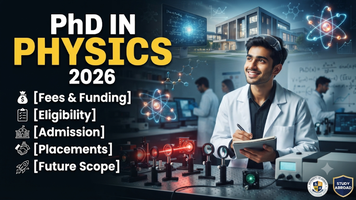
PhD in Physics: Fees, Eligibility Criteria, Admission, Placements and Future Scope 2026
Kirti Chauhan
Aug 19 2026
Learn More, Grow Faster
Get Updates Straight to Your Inbox!