
Ph.D. in Industrial and Product Design: Fees 2026, Eligibility, Admission Process, Placements and Future Scope
A Ph.D. in Industrial and Product Design is a research-based programme focused on product innovation, design technology, sustainability and user-centred solutions. This article covers Ph.D. in Industrial and Product Design fees, eligibility criteria, admission process, entrance exams, placements and career opportunities. Know about the future scope, top institutes, career options and skills needed to build a successful career in Industrial and Product Design research.
A Ph.D. in Industrial and Product Design is a research-oriented doctoral programme for students who want to explore advanced ideas in product development, industrial design, design innovation, user experience, materials, manufacturing and emerging technologies. The programme is suitable for candidates interested in design research, teaching, R&D, consultancy and innovation.
The duration, eligibility requirements and fee structure can vary from one university to another. For example, Bennett University offers a Ph.D. specifically in Product and Industrial Design, while institutions such as IISc and MIT Institute of Design offer doctoral-level research opportunities in closely related design and product-development areas.
Ph.D. in Industrial and Product Design: Highlights
| Particulars | Details |
| Course Name | Ph.D. in Industrial and Product Design |
| Course Level | Doctoral |
| Course Duration | Generally 3–6 years, depending on university and research progress |
| Field | Design, Product Development, Industrial Design |
| Eligibility | Master's degree in a relevant discipline |
| Minimum Marks | Usually around 55%, but varies by university |
| Admission | Entrance test, research proposal and interview/viva |
| Course Fee | Varies significantly by university |
| Mode | Full-time or part-time, depending on institute |
| Career Areas | Academia, R&D, product innovation, design consultancy, research and entrepreneurship |
What is a Ph.D. in Industrial and Product Design?
A Ph.D. in Industrial and Product Design focuses on original research related to the design, development and improvement of products and systems. Unlike a B.Des or M.Des, which primarily develops professional design skills, a Ph.D. requires students to identify a research problem and contribute new knowledge to the field.
Research can cover areas such as:
- Product design and development
- Industrial design
- Design thinking
- Human-centred design
- User experience and usability
- Sustainable product design
- Materials and manufacturing
- Automotive design
- Medical and healthcare product design
- Digital and smart products
- Design innovation
- Ergonomics
- Design for social impact
- Design research methodology
For instance, IISc's Centre for Product Design and Manufacturing describes doctoral research as involving in-depth research and contributions to the state of the art in design or manufacturing.
Ph.D. in Industrial and Product Design Eligibility Criteria
The eligibility criteria for Ph.D. in Industrial and Product Design differ across universities. In general, candidates need a postgraduate degree in design or a related discipline from a recognised university.
Basic Eligibility
Candidates generally need:
- A master's degree in Design, Industrial Design, Product Design, Engineering, Architecture, Fine Arts or a related field.
- Around 55% marks or equivalent CGPA in the qualifying postgraduate programme.
- A recognised bachelor's degree as required by the university.
- Candidates may need to clear a university-level Ph.D. entrance examination.
- Candidates with relevant national-level qualifications or fellowships may receive exemptions from the entrance test, depending on university rules.
For example, LPU's current eligibility information requires a one-year/two-semester master's degree with at least 55% aggregate marks or equivalent grades prescribed by the UGC.
MIT Institute of Design lists several relevant postgraduate qualifications for doctoral admission, including M.Des/M.Arch, M.Tech/ME and certain other relevant master's-level qualifications.
Is a Design Background Necessary for a Ph.D.?
Not always. Some universities accept applicants from related or even different academic backgrounds if their proposed research is relevant to the doctoral programme. For example, the World University of Design states that a design background is not essential for its Ph.D. programmes and applicants from other disciplines can apply.
Therefore, students should always check the specific eligibility criteria of the university before applying.
Ph.D. in Industrial and Product Design Fees
The Ph.D. Industrial and Product Design fees depend on factors such as the university, programme mode, research facilities and duration.
There is no single fee applicable to all institutions. Some universities charge fees semester-wise, while others have annual or programme-based fee structures.
As an indicative range, students may find doctoral design programmes costing from around Rs 1 lakh to several lakhs for the complete programme, depending on the institute and duration. Government-funded and research-oriented institutions can have substantially different fee structures from private universities.
What Does the Ph.D. Fee Usually Include?
Depending on the university, the fee may cover:
- Tuition fee
- Registration fee
- Research-related charges
- Examination fee
- Library facilities
- Laboratory or studio access
- Thesis evaluation
- Other institutional charges
Students should also consider additional expenses such as research materials, software, prototyping, travel, conferences and publication costs.
Ph.D. in Industrial and Product Design Admission Process
The Ph.D. admission process for Industrial and Product Design generally involves multiple stages.
Step 1: Check Eligibility
First, candidates should check whether they meet the university's academic requirements and any entrance-test conditions.
Step 2: Apply Online
Eligible candidates need to complete the university's Ph.D. application form and submit the required documents.
Step 3: Prepare a Research Proposal
A strong research proposal is an important part of doctoral admission. It should clearly explain:
- Proposed research topic
- Research problem
- Objectives
- Research questions
- Existing research or literature
- Proposed methodology
- Expected contribution
- References
Step 4: Ph.D. Entrance Examination
Many universities conduct a written entrance examination covering areas such as:
- Research methodology
- Subject knowledge
- Design fundamentals
- Analytical and logical reasoning
However, entrance-test requirements vary by institution.
Step 5: Interview or Viva Voce
Shortlisted candidates may have to appear for an interview. The panel may evaluate the candidate's:
- Research aptitude
- Subject knowledge
- Research proposal
- Academic background
- Problem-solving ability
- Understanding of the proposed research area
For example, World University of Design states that admission to its Ph.D. programmes is through a written test followed by an interview.
Step 6: Final Selection and Registration
Selected candidates complete the admission formalities and begin their doctoral research under a supervisor.
Ph.D. in Industrial and Product Design Entrance Exams
There is no single national entrance examination exclusively for Ph.D. in Industrial and Product Design.
Depending on the university and research area, admission may be based on:
- University-specific Ph.D. entrance test
- UGC-NET/JRF or equivalent qualification
- GATE, where applicable
- CEED or other design-related qualification, where accepted
- University interview and research proposal
The exact requirements should be checked with the institution before applying.
Ph.D. Industrial and Product Design Syllabus
The syllabus varies according to the university and research topic. Unlike undergraduate design courses, a Ph.D. is not based entirely on a fixed classroom syllabus.
Common areas can include:
Research Methodology
Students learn how to identify research problems, collect data, analyse findings and develop research frameworks.
Design Research
This covers research methods used to understand users, products, systems and design processes.
Product Design Development
Students may study advanced approaches to product ideation, prototyping, testing and evaluation.
Human-Centred Design
Research can focus on user needs, usability, ergonomics and interaction between people and products.
Sustainable Design
Students can explore environmentally responsible materials, circular design, lifecycle analysis and sustainable manufacturing.
Advanced Design Technologies
Depending on the research area, students may work with CAD, digital prototyping, 3D printing, AI, computational design, smart materials and other emerging technologies.
Thesis and Dissertation
The major component of the Ph.D. is the original research work that ultimately leads to a doctoral thesis.
Ph.D. in Industrial and Product Design Research Areas
Students can select a research topic based on their interests and the expertise available at the university.
Popular research areas include:
- Sustainable Product Design
- Automotive and Transportation Design
- Healthcare Product Design
- User-Centred Product Design
- Ergonomics and Human Factors
- Design for Manufacturing
- Smart Product Design
- Digital Product Development
- Inclusive Design
- Design for Social Innovation
- Materials and Product Innovation
- AI in Product Design
- Circular Economy and Product Design
- Design Thinking and Innovation
- Product-Service Systems
Industrial and product design research can therefore connect design, engineering, technology, business and social sciences.
Ph.D. in Industrial and Product Design Placements
Ph.D. placements are different from B.Des or M.Des placements. Doctoral students are generally trained for research-intensive positions rather than conventional entry-level design jobs.
Career opportunities can be available in:
- Universities and colleges
- Research institutions
- Corporate R&D departments
- Product development companies
- Design consultancies
- Automotive companies
- Consumer electronics companies
- Healthcare and medical-device companies
- Manufacturing organisations
- Technology companies
- Government research organisations
- Design innovation labs
A Ph.D. can also help candidates build careers as professors, design researchers, R&D specialists, innovation consultants and research leaders.
However, students should not judge a Ph.D. only by campus placement packages. The career value of the degree also depends on research publications, patents, portfolio, teaching experience, industry projects, networking and subject expertise.
Career Options After Ph.D. in Industrial and Product Design
After completing a Ph.D., graduates can explore several career paths.
1. Design Professor
Ph.D. graduates can pursue teaching and academic research positions at universities and design schools, subject to institutional recruitment requirements.
2. Design Researcher
Design researchers study users, products, technologies and design processes to generate new knowledge and improve products or services.
3. R&D Specialist
Companies in manufacturing, automotive, healthcare and technology need researchers who can work on product innovation and development.
4. Industrial Design Consultant
Experienced researchers can work with organisations on product strategy, innovation and design challenges.
5. Product Innovation Specialist
These professionals work on identifying opportunities and developing new or improved products.
6. UX and Human-Centred Design Researcher
Candidates with relevant research experience can work on usability, customer behaviour and user experience.
7. Design Strategist
Design strategists connect user research, business objectives and product development to solve complex problems.
8. Entrepreneur
A Ph.D. can also support innovation-led entrepreneurship, particularly when research results can be converted into products, technologies or services.
Ph.D. in Industrial and Product Design Salary
There is no fixed salary for Ph.D. in Industrial and Product Design graduates because salaries depend heavily on the job role, employer, experience and specialisation.
A fresh Ph.D. graduate entering academia may have a different salary structure from someone joining a corporate R&D team. Candidates with industry experience, patents, strong publications, specialised technical skills or leadership capabilities may command higher compensation.
Therefore, instead of focusing only on an average salary figure, students should evaluate the career role, research area, employer and long-term growth opportunities.
Future Scope of Ph.D. in Industrial and Product Design
The future scope of Industrial and Product Design research is expanding as companies increasingly focus on innovation, sustainability, digital products and user experience.
Emerging technologies are also changing how products are researched and developed. AI-assisted design, 3D printing, smart materials, connected devices, digital manufacturing and virtual prototyping are creating new research opportunities.
Major Future Trends
AI and Generative Design: AI can assist designers in generating and evaluating multiple design concepts.
Sustainable Product Development: Companies are increasingly looking for ways to reduce material consumption, waste and environmental impact.
Smart Products: IoT-connected and intelligent products are creating new opportunities for product-design research.
Healthcare Design: Medical devices, assistive products and patient-centred solutions remain important areas of innovation.
Inclusive Design: Products designed for people with different abilities, ages and backgrounds are becoming increasingly important.
Advanced Manufacturing: Additive manufacturing and digital production technologies are creating new possibilities for product development.
Human-Technology Interaction: As products become more intelligent and connected, understanding how people interact with technology is becoming increasingly important.
Is a Ph.D. in Industrial and Product Design Worth It?
A Ph.D. in Industrial and Product Design can be worth it for students who are genuinely interested in research, teaching, innovation or advanced R&D.
It may be a good choice if you:
- Want to become a design academic or professor
- Enjoy research and experimentation
- Want to work in advanced R&D
- Have a specific design problem you want to investigate
- Want to contribute to design knowledge
- Are interested in patents, publications or innovation
- Want to specialise in an emerging design field
However, a Ph.D. may not be necessary if your primary goal is to become a conventional product or industrial designer. In that case, a B.Des, M.Des or relevant professional experience may provide a more direct route into the design industry.
Ph.D. in Industrial and Product Design vs M.Des
| Factor | M.Des | Ph.D. |
| Level | Postgraduate | Doctoral |
| Main Focus | Professional design skills | Original research |
| Duration | Usually 2 years | Usually 3–6 years |
| Research | Moderate | Extensive |
| Thesis | Usually project/thesis | Major research thesis |
| Career | Product Designer, UX Designer, Design Consultant | Professor, Researcher, R&D Specialist |
| Industry Focus | High | Research and innovation focused |
| Best For | Professional design career | Research/academic/advanced R&D career |
Top Institutes for Ph.D. and Design Research in India
Students looking for doctoral opportunities in this area can explore institutes offering Product Design, Industrial Design, Design or related research programmes.
Some options include:
- Indian Institute of Science (IISc), Bengaluru
- Bennett University
- MIT Institute of Design
- Lovely Professional University
- World University of Design
- IITs and other universities with doctoral research in design-related disciplines
The exact availability of Industrial and Product Design Ph.D. specialisations can change by admission cycle, so candidates should verify the latest programme and supervisor information before applying.
Conclusion
A Ph.D. in Industrial and Product Design is an advanced research degree for students who want to move beyond professional design practice and contribute new ideas to the field. The programme combines design research, innovation, technology, user studies and problem-solving.
Before applying, students should compare the Ph.D. fees, eligibility criteria, research areas, faculty expertise, admission process, facilities and career opportunities offered by different universities. Choosing a supervisor and research topic that match your interests is particularly important because doctoral study is centred on long-term, original research.
FAQs on Ph.D. in Industrial and Product Design
What is a Ph.D. in Industrial and Product Design?
A Ph.D. in Industrial and Product Design is a doctoral research programme focused on generating new knowledge in areas such as product development, industrial design, user-centred design, sustainability, innovation and design technology.
What is the eligibility for a Ph.D. in Industrial and Product Design?
Generally, candidates need a master's degree in Design or a relevant discipline with around 55% marks or equivalent CGPA. Requirements vary by university.
How much does a Ph.D. in Industrial and Product Design cost?
The fees vary significantly between universities. Students may find programmes ranging from around Rs 1 lakh to several lakhs, depending on the institution, duration and programme structure.
What is the admission process for a Ph.D. in Industrial and Product Design?
The process generally includes checking eligibility, submitting an application, preparing a research proposal, appearing for an entrance test where applicable, and attending an interview or viva.
What can I do after a Ph.D. in Industrial and Product Design?
Graduates can work as design professors, design researchers, R&D specialists, innovation consultants, design strategists and product-development researchers or pursue entrepreneurship.
Is a Ph.D. in Product Design good for a career in industry?
Yes. It can be valuable for research-intensive industry roles, especially in product innovation, R&D, advanced manufacturing, healthcare, automotive and technology. However, candidates seeking conventional design roles may find an M.Des and industry experience more directly relevant.
Latest Articles
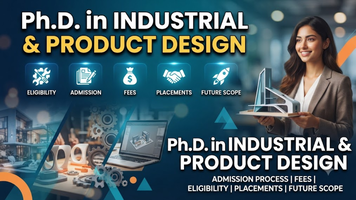
Ph.D. in Industrial and Product Design: Fees 2026, Eligibility, Admission Process, Placements and Future Scope
Kirti Chauhan
Sep 04 2026
AKTU Centre for Advanced Studies Opens MTech Admissions for 2026-27 Session
UniList Desk
Sep 04 2026
AUEET 2026 Final Phase Counselling: Web Option Entry Process Begins
UniList Desk
Sep 04 2026
IIT Patna Invites Applications for 4-Year Undergraduate BS Programmes in Tech Fields
UniList Desk
Sep 04 2026
UGC NET 2026 Re-Exam: Admit Cards for English, Commerce and Sociology Expected Soon
UniList Desk
Sep 04 2026
Allahabad University PhD Admission 2026: Registration Deadline and Application Process
UniList Desk
Sep 04 2026
ICSI Announces New Examination Centres for CS December 2026 Session
UniList Desk
Sep 04 2026
CEE Kerala Releases Final Category List for LLM Admission 2026
UniList Desk
Sep 04 2026
SGSITS Indore Introduces Hindi-Medium BTech Programme in Civil Engineering
UniList Desk
Sep 04 2026
SSC GD Constable Result 2026 Expected in Second Week of September
UniList Desk
Sep 04 2026
Learn More, Grow Faster
Get Updates Straight to Your Inbox!