
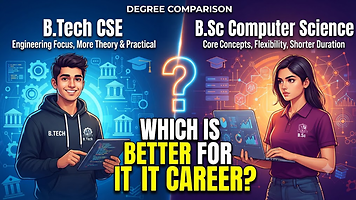
B.Tech CSE vs B.Sc Computer Science: Which Is Better for a Career in IT?
B.Tech CSE and B.Sc Computer Science are popular undergraduate options for students planning a career in IT. This article compares the two courses based on eligibility, syllabus, duration, career opportunities, higher studies and college options. It also covers 10 institutes and universities offering computer science-related undergraduate programmes.
Choosing the right undergraduate course is an important decision for students planning a career in the Information Technology (IT) sector. B.Tech in Computer Science and Engineering (CSE) and B.Sc in Computer Science are two popular options for students interested in programming, software development, data science, artificial intelligence and other technology-related fields.
While both courses cover computer science concepts, they differ in their course structure, duration, approach to learning and career pathways. This article explains the key differences between B.Tech CSE vs B.Sc Computer Science, including eligibility, syllabus, fees, career opportunities and higher education options.
What Is B.Tech Computer Science and Engineering?
A B.Tech in Computer Science and Engineering (CSE) is a four-year undergraduate degree that blends computer science principles with engineering fundamentals. It typically spans key areas such as programming, data structures, algorithms, computer networks, operating systems, databases, and software engineering, among other computing topics.
Many universities also offer exposure to emerging areas such as Artificial Intelligence (AI), Machine Learning (ML), Cloud Computing, Cybersecurity, Data Science, Internet of Things (IoT) and Blockchain.
For example, Bennett University’s B.Tech CSE programme is a four-year course with areas such as AI, ML, robotics, IoT, blockchain, AR/VR, cybersecurity and cloud computing included in its curriculum.
What Is B.Sc Computer Science?
B.Sc Computer Science is an undergraduate science degree that focuses on the theoretical and practical foundations of computer science. Depending on the university, students may study programming, algorithms, data structures, databases, computer networks, mathematics and software development.
Some B.Sc programmes combine Computer Science with another subject such as Mathematics or Statistics. For example, CHRIST (Deemed to be University) offers B.Sc programmes combining Computer Science with Mathematics and Statistics.
B.Sc Computer Science can be suitable for students who are interested in computing, programming, mathematics and analytical concepts and may also want to pursue postgraduate education.
What Is the Difference Between B.Tech CSE and B.Sc Computer Science?
The major differences between the two programmes are related to their academic approach and course structure.
| Factor | B.Tech CSE | B.Sc Computer Science |
| Degree type | Engineering degree | Science degree |
| Typical duration | 4 years | Usually 3–4 years, depending on programme |
| Focus | Computer science + engineering | Computer science + scientific and mathematical foundations |
| Learning approach | Theory, engineering, labs and projects | Theory, programming, mathematics and practical learning |
| Common subjects | Programming, DSA, OS, DBMS, networks, engineering subjects | Programming, DSA, mathematics, algorithms, databases and computer science subjects |
| Emerging technologies | Often includes AI, ML, cloud, cybersecurity, IoT and related areas | Availability depends on university and programme |
| Higher studies | M.Tech, MS, MBA, MCA and other postgraduate programmes | MCA, MSc, MS, MBA and other postgraduate programmes |
| Career options | Software engineer, developer, data/AI roles, cybersecurity and cloud roles | Software developer, data analyst, programmer, testing and other IT roles |
Which Course Has More Scope in IT: B.Tech CSE or B.Sc Computer Science?
Both degrees can lead to careers in the IT sector. The difference is generally in the academic route rather than whether one degree can lead to an IT career.
A B.Tech CSE programme usually provides an engineering-oriented curriculum along with computer science subjects, laboratories, projects and technical training. For example, IIT Delhi's B.Tech CSE curriculum includes programming, data structures, basic sciences, engineering courses, departmental core subjects and electives.
B.Sc Computer Science focuses more directly on computer science and related scientific or mathematical subjects. At CHRIST University, for instance, the B.Sc Computer Science and Mathematics programme covers programming, algorithms, data structures, software engineering and mathematical concepts.
Students should therefore compare the syllabus, practical exposure, internships, entrance requirements and higher-study options of individual institutions.
What Subjects Are Taught in B.Tech CSE?
The syllabus varies by university, but common B.Tech CSE subjects include:
- Programming
- Data Structures
- Algorithms
- Database Management Systems
- Computer Networks
- Operating Systems
- Computer Architecture
- Software Engineering
- Artificial Intelligence
- Machine Learning
- Web Development
- Cloud Computing
- Cybersecurity
- Mathematics
- Computer Organisation
- Internet of Things
Some institutions also provide specialisations or focus areas. IIT Bombay's B.Tech CSE programme, for example, offers optional focus areas including Artificial Intelligence, Computing Systems, Computer Security and Theoretical Computer Science.
What Subjects Are Taught in B.Sc Computer Science?
Common B.Sc Computer Science subjects may include:
- Programming
- Data Structures
- Algorithms
- Database Management
- Computer Networks
- Operating Systems
- Computer Architecture
- Software Engineering
- Discrete Mathematics
- Statistics
- Calculus
- Web Technologies
- Computer Applications
- Artificial Intelligence
- Data Science
The exact combination depends on the university. Some B.Sc programmes combine Computer Science with Mathematics or Statistics, allowing students to develop both computing and analytical skills.
What Are the Eligibility Criteria for B.Tech CSE?
Eligibility requirements vary by institution. In general, students need to complete Class 12 with subjects such as Physics and Mathematics, along with other required subjects.
For example, Bennett University states that Indian students applying for B.Tech CSE should have passed Class 12 with Physics and Mathematics and another eligible subject, with at least 55% marks as specified by the university.
Students may also need to appear for an entrance examination depending on the institution.
What Are the Eligibility Criteria for B.Sc Computer Science?
Eligibility for B.Sc Computer Science varies between universities. Many institutions require students to have completed Class 12, with Mathematics or a related subject requirement depending on the programme.
For example, some B.Sc Computer Science programmes combine computer science with Mathematics or Statistics. Students should check the specific eligibility criteria, subject requirements and admission process of the university they are considering.
Which Course Is More Suitable for Software Development?
Both B.Tech CSE and B.Sc Computer Science can provide a foundation for software development.
B.Tech CSE generally includes a broader engineering curriculum along with core computer science subjects. B.Sc Computer Science can provide a focused foundation in programming, algorithms and computer science.
For either course, students can improve their software development skills through:
- Coding practice
- Programming projects
- Internships
- Open-source contributions
- Hackathons
- Industry certifications
- Problem-solving practice
- Portfolio projects
The degree is only one part of preparing for a software development career. Practical skills and project experience are also important.
What Are the Career Options After B.Tech CSE?
After completing B.Tech CSE, graduates can explore roles such as:
- Software Developer
- Software Engineer
- Web Developer
- Application Developer
- Data Analyst
- Data Scientist
- Machine Learning Engineer
- AI Engineer
- Cloud Engineer
- Cybersecurity Analyst
- Database Administrator
- Network Engineer
- DevOps Engineer
- Systems Analyst
The availability of specific roles depends on the candidate's skills, experience, academic background and employer requirements.
What Are the Career Options After B.Sc Computer Science?
B.Sc Computer Science graduates can also explore several IT-related roles, including:
- Software Developer
- Web Developer
- Programmer
- Data Analyst
- Technical Support Executive
- QA Tester
- Database Administrator
- System Administrator
- IT Support Specialist
- Junior Data Scientist
- Cybersecurity Associate
Some students choose to pursue MCA, MSc Computer Science, MSc Data Science, MS or other postgraduate programmes to build advanced technical knowledge.
Which Colleges Can Students Consider for Computer Science in India?
Students can explore universities and institutes offering computer science-related undergraduate programmes. The following list is not a ranking; it provides examples of institutions offering relevant programmes.
1. Indian Institute of Technology Bombay
IIT Bombay offers a B.Tech programme in Computer Science and Engineering. Its curriculum includes computer science fundamentals and provides options such as focus areas in Artificial Intelligence, Computing Systems, Computer Security and Theoretical Computer Science.
2. Indian Institute of Technology Delhi
IIT Delhi offers a B.Tech in Computer Science and Engineering. Its curriculum covers computer science fundamentals along with engineering, science, project and elective components.
3. Indian Institute of Technology Madras
IIT Madras is another institution students can consider for undergraduate study in computer science and related technology fields. Admission and programme requirements should be checked on the institute's official website for the relevant academic year.
4. National Institute of Technology Tiruchirappalli
NIT Tiruchirappalli offers a B.Tech programme in Computer Science and Engineering. The programme covers hardware and software concepts and includes areas such as distributed computing, parallel architecture, networking and multimedia systems.
5. Vellore Institute of Technology
VIT offers B.Tech Computer Science and Engineering along with several CSE-related specialisations. Its School of Computer Science and Engineering states that its curricula are designed around changing technology and industry requirements.
6. Manipal Institute of Technology
Manipal Institute of Technology offers a four-year B.Tech in Computer Science and Engineering. The programme includes areas such as AI and ML, Data Science, Software Engineering, Cybersecurity, IoT and Robotics.
7. SRM Institute of Science and Technology
SRM Institute of Science and Technology offers undergraduate programmes in Computer Science and Engineering and related specialisations. Students can check the university's current programme structure and admission requirements before applying.
8. Amity University
Amity University offers B.Tech Computer Science and Engineering programmes. Its CSE curriculum includes programming, mathematics, engineering subjects and computer science concepts, with programme structures varying by campus.
9. CHRIST (Deemed to be University)
CHRIST University offers B.Sc programmes combining Computer Science with subjects such as Mathematics and Statistics. These programmes include areas such as programming, algorithms, data structures and software engineering.
10. Bennett University
Bennett University offers a four-year B.Tech in Computer Science and Engineering. The programme includes exposure to AI, Machine Learning, Robotics, IoT, Blockchain, AR/VR, Cybersecurity and Cloud Computing. It also offers multiple specialisations and project-based learning opportunities.
The current published tuition fee for Bennett University's standard B.Tech CSE programme is ₹15.70 lakh for four years, excluding other applicable charges. The university notes that fees may be revised for a new academic year.
What Is the Difference in Career Growth After B.Tech CSE and B.Sc Computer Science?
Career growth after either course depends on several factors, including technical skills, internships, work experience, specialisation and higher education.
A B.Tech CSE graduate may directly apply for a range of engineering and technology positions. A B.Sc Computer Science graduate can also enter IT roles and may choose an MCA, MSc or other postgraduate qualification to develop specialised knowledge.
For both degrees, knowledge of programming languages such as Python, Java, C++ or JavaScript can be useful. Students can also build skills in areas such as:
- Artificial Intelligence
- Machine Learning
- Data Science
- Cloud Computing
- Cybersecurity
- Full-Stack Development
- DevOps
- Mobile Application Development
Which Course Should You Choose After Class 12?
The choice between B.Tech CSE and B.Sc Computer Science depends on the student's academic interests, career plans, preferred learning style and eligibility.
B.Tech CSE may suit students who:
- Want an engineering-oriented undergraduate degree
- Are comfortable studying Mathematics and Physics
- Want a combination of engineering and computer science
- Are interested in technical projects and engineering applications
- Want to explore areas such as AI, cloud, cybersecurity and software engineering
B.Sc Computer Science may suit students who:
- Prefer a science-oriented degree
- Are interested in computer science and mathematics
- Want to focus on programming and computing concepts
- Are considering MCA, MSc or other postgraduate study
- Want flexibility to build specialised technical skills independently
B.Tech CSE vs B.Sc Computer Science: Which Has Better Career Opportunities?
Both degrees can lead to careers in IT, software development, data, cybersecurity and other technology fields. The difference lies mainly in the structure and academic orientation of the programmes.
Students should compare course curriculum, college reputation, fees, entrance requirements, internships, placement opportunities, laboratories, faculty, industry exposure and higher-study options before making a decision.
A strong portfolio of coding projects, internships and relevant technical skills can also make a significant difference when applying for technology jobs.
Conclusion
B.Tech CSE and B.Sc Computer Science both provide pathways into the IT sector, but they offer different academic approaches. B.Tech CSE combines computer science with engineering education, while B.Sc Computer Science focuses more directly on computer science and scientific or mathematical concepts.
Before selecting a course, students should compare the curriculum, eligibility, fees, practical exposure, internships, placements, specialisations and higher education opportunities offered by individual colleges. Building strong technical skills alongside the degree can also help students prepare for careers in software development, data science, AI, cybersecurity, cloud computing and other areas of IT.
FAQs
Is B.Tech CSE better than B.Sc Computer Science for IT jobs?
Both degrees can lead to IT jobs. B.Tech CSE follows an engineering-oriented curriculum, while B.Sc Computer Science follows a science-oriented curriculum. Students should compare individual college programmes and career requirements before choosing.
Can B.Sc Computer Science graduates become software engineers?
Yes. B.Sc Computer Science graduates can pursue software development and related IT roles by developing programming, data structures, algorithms and software development skills.
Is B.Tech CSE a four-year course?
Yes. B.Tech CSE is generally a four-year undergraduate programme divided into eight semesters.
Can I do MCA after B.Sc Computer Science?
Yes, B.Sc Computer Science graduates can pursue MCA if they meet the eligibility requirements of the university or institution offering the programme.
Can I pursue higher studies after B.Tech CSE?
Yes. B.Tech CSE graduates can consider programmes such as M.Tech, MS, MBA and other postgraduate courses, subject to the eligibility criteria of the institution.
Which subjects are important for B.Tech CSE?
Programming, Mathematics, Data Structures, Algorithms, Database Management, Operating Systems, Computer Networks and Software Engineering are among the important areas commonly covered in B.Tech CSE programmes.
Which skills should I learn with B.Sc Computer Science?
Students can build skills in programming languages, data structures and algorithms, databases, web development, cloud computing, cybersecurity, data analysis and AI/ML depending on their career interests.
Latest Articles
B.Tech CSE vs B.Sc Computer Science: Which Is Better for a Career in IT?
Kirti Chauhan
Sep 18 2026
AIBE 22 Registration Open: Check Eligibility and Exam Schedule for 2026
UniList Desk
Sep 18 2026
JEE Main 2027 Session 1 Dates Overlap With Maharashtra and West Bengal Board Practicals
UniList Desk
Sep 18 2026
AKTU Releases Official Guidelines for BTech Branch Change for 2026-27 Session
UniList Desk
Sep 18 2026
Maharashtra AYUSH Admission 2026: Registration for Round 1 Closes Today
UniList Desk
Sep 18 2026
WBMCC Releases NEET UG 2026 Round 3 and Stray Vacancy Round Schedule
UniList Desk
Sep 18 2026
YCMOU Extends Admission Deadline for 2026-27 Academic Session
UniList Desk
Sep 18 2026
Maharashtra Engineering Aspirants Await MHT CET 2027 Exam Schedule
UniList Desk
Sep 18 2026
Karnataka PGCET 2026 Mock Seat Allotment Results Expected Today
UniList Desk
Sep 18 2026
MHCET Law 5-Year LLB 2026: CAP Round 3 Seat Allotment Results Released
UniList Desk
Sep 18 2026
Learn More, Grow Faster
Get Updates Straight to Your Inbox!