
IIT Madras introduces Asia's largest shallow wave basin for coastal research
IIT Madras has introduced Asia's largest shallow wave basin , it is for fostering coastal research. The initiative showed commitment towards research and innovation.The Indian Institute of Technology (IIT) Madras has introduced Asia’s largest Shallow Wave Basin Research Facility. It is a groundbreaking infrastructure designed to meet the needs of research and industry. The pro facility is situated at the Discovery Satellite Campus in Thaiyur, which is 36km from IIT Madras.It signifies the country’s growing technical and research prowess in coastal and marine engineering.
It has been built under the National Technology Centre for Ports, waterways and Coasts (NTCPWC), the facility is important in addressing difficulties related to Indian ports, waterways and coastal engineering. It has a multi-directional shallow wave basin which is capable of analysing complex wave-current interactions.
Talking about the significance of the research, Prof. K. Murali from Department of Ocean Enginerring at IIT Madras said,"This facility places IIT Madras on the global map as one of the few institutions equipped with such a large-scale shallow wave basin for research and industrial applications. It eliminates the need for external technological dependence for laboratory wave generation."
Focusing on its indigenous nature, Prof. V Sriram, from the same department expressed, "Most of the Shallow Wave Basin was developed as part of the ‘Make in India’ initiative. Except for a few imported components, the design, architecture, and fabrication were carried out in-house, ensuring long-term sustainability and efficiency of the facility."
The basin has a number of applications , from testing the effects of 3D waves on structures to aiding in harbor, offshore, coastal, and inland water projects.
It provides studies on sediment transport, wave impact loading and structural stability in climate change. The facility can support several projects at a time thus making it a versatile tool for research.
By this creation, IIT Madras has shown its significance to fostering technological innovation while working on the critical challenges in marine and coastal engineering.
Top Management Colleges
NIT Trichy - National Institute of Technology
TiruchirappalliLatest Articles

How to Become an Income Tax Officer in India: Qualification, Exams & Salary Guide
UniList Desk
Feb 28 2026
Self-Study vs Coaching for Government Exams: What Should You Choose?
UniList Desk
Feb 28 2026
10 Government Jobs With High Salary in India
UniList Desk
Feb 28 2026
BPT vs BOT: Which Physiotherapy Career Path Should You Choose?
UniList Desk
Feb 28 2026
How to Become an RBI Grade B Officer: A Complete Guide
UniList Desk
Feb 28 2026
Corporate Law vs Criminal Law: Scope, Challenges & Career Opportunities
UniList Desk
Feb 27 2026
Top 10 Common Mistakes to Avoid in Government Exam Preparation
UniList Desk
Feb 27 2026
How to Become a Lecturer or Professor in India Without UGC NET: A Complete Guide
UniList Desk
Feb 27 2026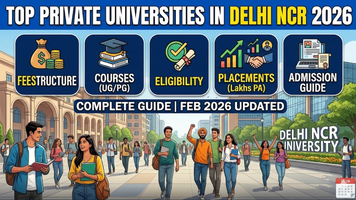
Top Private Universities in Delhi NCR 2026: Fees, Courses, Eligibility, Placements & Admission Guide
Kirti Chauhan
Feb 27 2026
CLAT PG vs AILET PG: Which Law Entrance Exam is Tougher?
UniList Desk
Feb 27 2026
Learn More, Grow Faster
Get Updates Straight to Your Inbox!